Intro
Many AI tools for social media start with the same prompt: "Give me ten content ideas for this product." The output usually looks fine on the screen. The problem shows up after publishing. The posts may earn views, but they often do not answer a real audience question, support a search strategy, or give the team a useful next step.
The missing input is search intent. Not keyword volume by itself, but the language people use when they are trying to compare tools, fix a problem, learn a process, or find a template. When that intent becomes part of the social workflow, the content brief changes. The team is no longer asking an AI system to invent ideas from a product description. It is asking the system to translate market demand into formats people are already likely to understand.
The strongest loop runs in both directions. Search signals help decide what a short-form team should test next. Short-form results help decide which search topics deserve deeper pages, better FAQs, or clearer landing-page copy. That is the difference between publishing more content and building a system that learns.
Start With Intent, Not Just Volume
Search volume is useful, but it is not a strategy. A query like "AI social media manager" suggests tool comparison. A query like "short form content strategy" suggests planning and education intent. A query like "UGC creator brief template" suggests immediate execution. Those three searches should not all become the same blog post, landing page, or video hook.
Before writing or filming, the team should decide what the searcher is trying to finish. Are they comparing options? Trying to learn a workflow? Looking for a usable template? Trying to brief a creator without losing context? That decision affects the page format, the opening line, the call to action, and the proof the content needs to carry.
This is where keyword research becomes more useful for production teams. A keyword list can tell you where demand exists. Intent analysis tells you what job the content has to do. If a topic is mostly educational, the best social asset may be a step-by-step clip or a carousel-style explainer. If the topic is comparison-heavy, the better asset may be a side-by-side workflow. If the topic is template-driven, the content should give people something concrete to copy or adapt.
Turn Query Clusters Into Campaign Briefs
A useful campaign brief translates search demand into creative decisions. If the query cluster is about planning, the brief should include before-and-after calendar examples, decision rules, and common mistakes. If the cluster is about templates, the brief should include fields, examples, and handoff notes. If the cluster is about tools, the brief should show the workflow and where software fits without pretending it replaces operator judgment.
This is where an AI social media agent can help a small team keep the loop organized. The goal is not to generate random posts. The goal is to take brand context, search intent, profile signals, reference videos, and product proof, then turn them into campaign ideas, hooks, scripts, shot plans, and creator-ready briefs. That gives the team one planning surface instead of scattered keyword sheets, social notes, and disconnected drafts.
The All-in-One Platform for Effective SEO
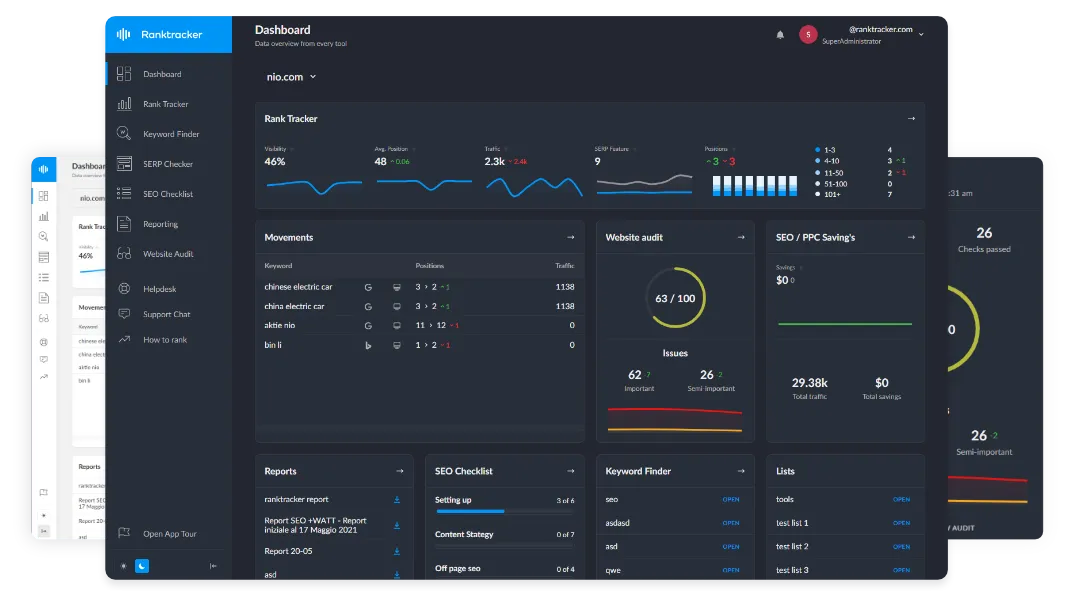
Behind every successful business is a strong SEO campaign. But with countless optimization tools and techniques out there to choose from, it can be hard to know where to start. Well, fear no more, cause I've got just the thing to help. Presenting the Ranktracker all-in-one platform for effective SEO
We have finally opened registration to Ranktracker absolutely free!
Create a free accountOr Sign in using your credentials
The brief should make the reasoning visible. A producer or creator should be able to see the query, the intent behind it, the audience objection, the format being tested, and the page or offer the content should support. Without that context, the handoff becomes a loose suggestion. With it, the creative work stays tied to the market signal that justified it.
Use Short-Form Results To Prioritize SEO Work
Short-form performance can also be a research input for SEO. A video with an unusually strong save rate may point to a topic people want to revisit. Repeated comments can reveal a missing FAQ. A hook that holds attention may contain clearer language than the page title currently used on the site. A post that earns profile visits but few site clicks may show that the handoff is weak, not that the topic is wrong.
For example, if a team publishes several clips about content planning and viewers keep asking how to choose between TikTok, Reels, and Shorts, the next SEO task is probably not another generic "best practices" page. It may be a platform-specific planning guide, a comparison page, or a decision framework. A short form content strategy guide can then act as the stable destination that social posts, newsletters, and internal links point toward.
This feedback loop helps teams avoid two common mistakes. The first is chasing broad keywords that do not match the product's strongest workflow. The second is producing short-form content that earns surface-level attention but never teaches the site what to rank for next. When the loop works, every campaign leaves a better map behind it.
Keep The Workflow Measurable
The practical measurement stack does not need to be complicated. At the search layer, track impressions, click-through rate, average position, indexed pages, and the queries that start appearing around each topic. At the social layer, track hook retention, saves, shares, comments, qualified profile visits, and site clicks. At the product layer, track whether visitors paste a URL, generate a brief, start a trial, or ask for managed execution.
The important part is not the dashboard. It is the habit of reading both channels together. If a post gets strong saves but the matching page gets low click-through from search, the page may need clearer title language. If a page starts ranking for a question that never appears in social comments, the team may have found a topic worth explaining in short-form. If social comments repeat the same objection that searchers also type into Google, that objection deserves its own brief and its own page section.
What The Agent Should Not Pretend To Do
It is worth being direct about the limits. This kind of workflow does not mean an AI tool films the final video, posts on behalf of the brand, buys ads, or guarantees that a campaign will grow. Those claims are usually where AI marketing copy loses credibility.
The useful role is narrower and more practical. The agent helps preserve context from research to production. It can organize the inputs, suggest angles, structure briefs, and make the next test easier to run. The final judgment still belongs to the team: what is accurate, what fits the brand voice, what should be filmed, and what deserves budget.
A Weekly Rhythm That Keeps The Loop Running
Most teams do not fail at this workflow because the idea is too complex. They fail because there is no fixed time to run it. A workable weekly rhythm is enough.
- Monday: Review last week's strongest short-form posts. Note hooks, saves, comments, site clicks, and any repeated questions.
- Tuesday: Pull keyword and "People Also Ask" data for two priority topics. Group the findings by intent, not just volume.
- Wednesday: Turn the strongest cluster into two or three campaign briefs. Each brief should include the query, intent, angle, proof, and format.
- Thursday: Hand the briefs to a producer, creator, or in-house operator with the context still attached.
- Friday: Publish one or two tests and write down what the team expects to learn.
At the end of each month, the team has more than a pile of posts. It has a record of which intent types perform best, which topics deserve deeper pages, and which audience questions keep appearing across channels. That record is more useful than one isolated keyword win or one viral clip.
Common Mistakes That Break The Loop
Treating every keyword the same
High volume does not always mean high opportunity. A lower-volume query with a clear execution need can be more valuable than a broad query where the searcher is still vague. Volume is a starting point, not a decision.
Letting AI write the final post unchecked
AI can be useful for briefs, drafts, and structure. It should not be the last set of eyes on something an audience will judge in seconds. Native voice, accuracy, and editorial judgment still matter.
Ignoring the comment section
Comments are free audience research. A team that reads and tags its own comments will often learn faster than a team that only watches reach and impressions.
Measuring search and social separately
If the two channels never appear on the same page, nobody sees how the language travels. A single weekly view of both is often enough to make the loop visible.
The Takeaway
Search signals make AI-assisted social workflows more grounded. Instead of producing content that sounds plausible, the team produces content that answers something real. Instead of chasing volume, the team studies intent. Instead of running SEO and social as separate calendars, the team uses both as one feedback loop.
That shift does not require a larger team or a larger budget. It requires a clear process and the discipline to run it every week. For lean marketing teams, that is the practical advantage: fewer handoffs, clearer briefs, and a shorter path from market signal to publishable campaign.