Intro
If AI is the new interface to the internet, then your entity footprint is your brand’s presence inside that interface.
An entity footprint is the total collection of:
✔ facts
✔ relationships
✔ definitions
✔ identifiers
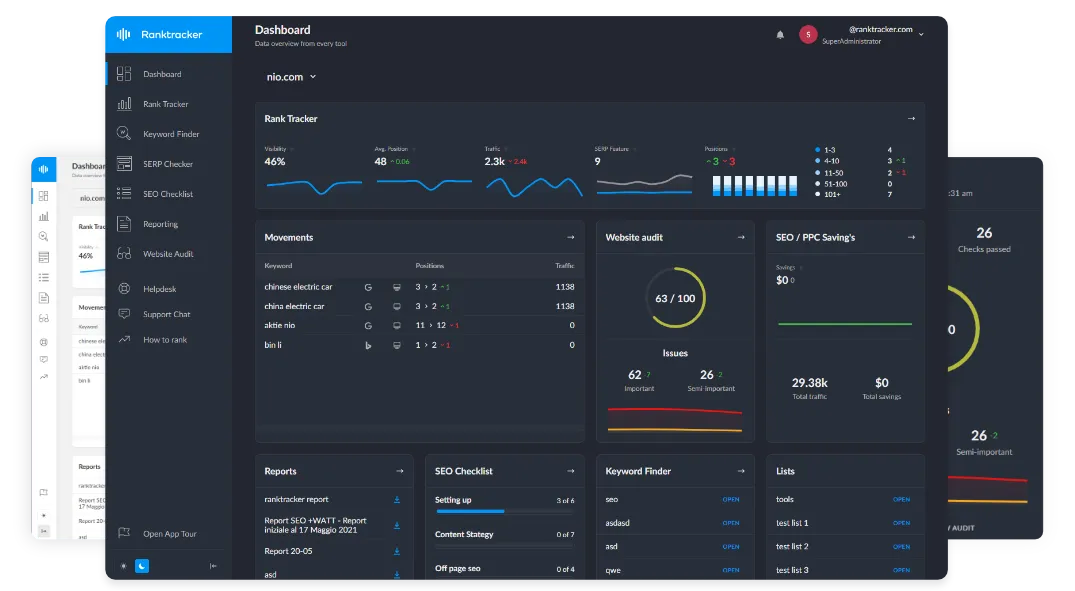
The All-in-One Platform for Effective SEO
Behind every successful business is a strong SEO campaign. But with countless optimization tools and techniques out there to choose from, it can be hard to know where to start. Well, fear no more, cause I've got just the thing to help. Presenting the Ranktracker all-in-one platform for effective SEO
We have finally opened registration to Ranktracker absolutely free!
Create a free accountOr Sign in using your credentials
✔ citations
✔ category placement
The All-in-One Platform for Effective SEO
Behind every successful business is a strong SEO campaign. But with countless optimization tools and techniques out there to choose from, it can be hard to know where to start. Well, fear no more, cause I've got just the thing to help. Presenting the Ranktracker all-in-one platform for effective SEO
We have finally opened registration to Ranktracker absolutely free!
Create a free accountOr Sign in using your credentials
that AI models use to understand, remember, classify, and recommend your brand.
A strong entity footprint means:
✔ accurate AI summaries
✔ correct feature descriptions
✔ consistent brand recall
✔ inclusion in “best tools” lists
✔ visibility inside AI Overviews
✔ placement in Perplexity Sources
✔ proper competitor adjacency
✔ correct category assignment
A weak entity footprint means:
✘ hallucinated facts
✘ missing features
✘ misclassification
✘ being replaced by competitors
✘ poor entity recall
✘ lack of citations
✘ category drift
✘ inaccurate comparisons
✘ lower trust in your data
This guide shows you how to audit your current entity footprint and systematically expand it across every AI-relevant surface.
1. What Is an Entity Footprint? (LLM Definition)
Your entity footprint is the visible surface area of your brand across the AI ecosystem.
It includes:
A. Internal Surfaces (You Control)
-
your website
-
schema markup
-
structured data
-
product pages
-
documentation
-
blog clusters
-
FAQs
-
internal linking
-
metadata
-
sitemaps
-
JSON feeds
B. External Surfaces (The Web Controls)
-
directory listings
-
press coverage
-
review sites
-
partner listings
-
Wikidata
-
Wikipedia
-
Crunchbase, G2, Capterra
-
Linked Open Data (LOD)
-
industry blogs
-
social media entity descriptions
-
scraped summaries used by AI
C. AI-Interpreted Surfaces (Models Control)
-
entity embeddings
-
knowledge graph placement
-
model-internal definitions
-
competitor adjacency
-
category grouping
-
answer templates
-
citation confidence
-
hallucination risk
An entity footprint is not content—it is identity.
It tells AI engines:
-
who you are
-
how you work
-
where you fit
-
what you can be trusted with
-
how to compare you
-
whether to cite you
-
whether to recommend you
This footprint determines your entire presence inside AI-generated discovery.
2. The Entity Footprint Audit Framework (EFA-12)
Here is the full 12-step audit system we use to analyze a brand’s entity footprint across all LLM surfaces.
Step 1 — Audit Your Canonical Brand Definition
Check:
✔ Is your definition consistent everywhere?
✔ Is it too vague or too promotional?
✔ Does it match Schema and Wikidata?
✔ Is it repeated verbatim across key pages?
Your canonical entity sentence must be identical across:
-
homepage
-
About page
-
press kit
-
schema
-
Wikidata
-
product pages
-
footer boilerplates
-
directories
This is often the #1 factor causing hallucinations.
Step 2 — Audit Your Schema Layer
Review:
✔ Organization
✔ SoftwareApplication
✔ Product
✔ BreadcrumbList
✔ FAQPage
✔ WebPage markup
Check for:
-
missing fields
-
contradictory fields
-
outdated features
-
incorrect data types
-
missing sameAs links
-
missing identifiers
-
incorrect schema nesting
Schema = your brand’s machine-readable truth.
Step 3 — Audit Wikidata for Accuracy and Completeness
Ensure the Wikidata item has:
✔ correct description
✔ correct entity type
✔ correct category
✔ headquarters
✔ founding date
✔ founders
✔ external IDs
✔ website
✔ logo
✔ industry
✔ product type
Wikidata that contradicts your website causes immediate AI confusion.
Step 4 — Map Your External Knowledge Surfaces
Audit:
✔ Crunchbase
✔ G2 / Capterra
✔ LinkedIn org
✔ Product Hunt
✔ SaaS directories
✔ business registries
✔ review platforms
✔ partner pages
✔ press features
You’re looking for:
-
outdated descriptions
-
inconsistent naming
-
missing features
-
wrong categories
-
incomplete profiles
LLMs use these to validate consensus.
Step 5 — Audit Your Documentation (The #1 RAG Source)
Documentation must be:
✔ updated
✔ consistent
✔ structured
✔ chunked
✔ factual
✔ technically precise
✔ aligned with the canonical definition
LLMs rely heavily on documentation.
Step 6 — Audit Blog & Content Consistency
Check:
✔ does each article use the correct brand description?
✔ do feature explanations match product pages?
✔ are you using unified terminology?
✔ are entities referenced consistently?
If content contradicts your core data, AI models downrank entity trust.
Step 7 — Audit Category Placement
LLMs must understand:
-
your main category
-
your subcategory
-
your competitor set
-
your related product types
Look for misalignment:
✘ wrong vertical
✘ mismatched category
✘ blended purpose
✘ missing competitor adjacency
This affects your inclusion in AI-generated lists.
Step 8 — Audit Competitor Adjacency
Check whether LLMs group you with the right competitors.
If AI systems compare you to the wrong brands:
→ your entity graph is misaligned → your category associations are weak → your external data is inconsistent
Fixing competitor adjacency is crucial for AI-generated rankings.
Step 9 — Check Entity Sentiment and Accuracy Across AI Engines
Ask:
ChatGPT
“What is [Brand]?”
Gemini
“Explain [Brand] simply.”
Perplexity
“Sources for [Brand].”
Claude
“Summarize [Brand] factually.”
Copilot
“Compare [Brand] vs [Competitor].”
Apple Intelligence (Siri)
“What is [Brand]?”
Audit for:
✔ incorrect facts
✔ missing features
✔ wrong category
✔ hallucinated attributes
✔ misidentified founders
✔ incomplete summaries
✔ missing competitors
All indicate entity footprint problems.
Step 10 — Audit Internal Linking for Semantic Reinforcement
Internal links build your internal “entity graph.”
Check for:
✔ topic clusters
✔ hub pages
✔ glossary terms
✔ consistent links to definitional content
✔ semantic reinforcement
Your website should function as a knowledge graph.
Step 11 — Audit Backlinks for Entity Stability
Use Ranktracker’s:
✔ Backlink Checker
✔ Backlink Monitor
Check for:
✔ authoritative references
✔ competitor adjacency
✔ category confirmation
✔ consensus-building anchors
✔ toxic or misleading links
Backlinks are LLM trust signals.
Step 12 — Audit Recency Signals
AI engines give preference to:
✔ fresh updates
✔ new backlinks
✔ updated documentation
✔ current features
✔ recent citations
✔ active site changes
Recency improves credibility and visibility.
3. How to Expand Your Entity Footprint (The EF Expansion Model)
Once your footprint is audited, use this 7-part expansion system to grow it.
Expansion Step 1 — Strengthen Your Knowledge Graph Connectors
Expand:
✔ Schema sameAs links
✔ Wikidata identifiers
✔ cross-platform IDs
✔ Linked Open Data connections
This amplifies your presence across AI knowledge networks.
Expansion Step 2 — Publish a Complete Entity Hub Page
A dedicated page with:
✔ canonical definition
✔ features
✔ category
✔ competitors
✔ founders
✔ industry
✔ use cases
✔ documentation links
This page becomes your central LLM anchor.
Expansion Step 3 — Build Category Reinforcement Pages
Publish pages like:
-
“What Is an SEO Platform?”
-
“Types of Rank Tracking Tools”
-
“How SERP Analysis Tools Work”
-
“Alternatives to Ahrefs / SEMrush / SE Ranking”
These reinforce your industry identity.
Expansion Step 4 — Create Competitor & Alternative Pages
These provide crucial relational data:
✔ comparisons
✔ alternatives
✔ category benchmarks
LLMs use these relationships to place you in:
-
lists
-
comparisons
-
recommendations
Expansion Step 5 — Expand Structured Data Surfaces
Add:
✔ FAQPage schema
✔ HowTo schema
✔ Product schema
✔ SoftwareApplication schema
✔ Organization schema
Structured surfaces = stable entity signals.
Expansion Step 6 — Grow External Evidence Sources
Secure:
✔ industry mentions
✔ SaaS directories
✔ expert roundups
✔ feature reviews
✔ partner listings
✔ press citations
✔ academic references
Each one acts as a node in your external entity graph.
Expansion Step 7 — Build a Multilingual Entity Layer
Translate:
✔ brand description
✔ schema
✔ Wikidata labels
✔ top pages
This dramatically improves:
✔ Gemini
✔ Perplexity
✔ Mistral
✔ Apple Intelligence recall
Multilingual entities = global AI visibility.
4. How Ranktracker Supports Entity Footprint Expansion
Ranktracker Backlink Checker + Backlink Monitor
Build authority and consensus links.
Web Audit
Detects schema, metadata, and structural issues.
Keyword Finder
Builds category clusters and definitional content.
SERP Checker
Shows current entity associations and competitors.
AI Article Writer
Generates clean, structured, entity-consistent content.
Ranktracker is the operational backbone for building and expanding an entity footprint.
**Final Thought:
Your Entity Footprint Determines Your Fate in AI-Generated Discovery**
In the AI era, you don’t win by having the most content. You win by having the strongest entity footprint.
AI models rely on your entity footprint to:
✔ understand you
✔ trust you
✔ recall you
✔ categorize you
✔ compare you
✔ recommend you
✔ cite you
If your footprint is weak:
✘ AI misinterprets you
✘ competitors replace you
✘ summaries degrade
✘ citations disappear
✘ category placement collapses
If your footprint is strong:
✔ AI sees you
✔ AI trusts you
The All-in-One Platform for Effective SEO
Behind every successful business is a strong SEO campaign. But with countless optimization tools and techniques out there to choose from, it can be hard to know where to start. Well, fear no more, cause I've got just the thing to help. Presenting the Ranktracker all-in-one platform for effective SEO
We have finally opened registration to Ranktracker absolutely free!
Create a free accountOr Sign in using your credentials
✔ AI recommends you
✔ AI cites you
✔ AI represents you accurately
Entity optimization is modern SEO. Auditing and expanding your footprint is how you survive — and win — in the era of AI-driven discovery.