Intro
For years, SEO reporting has revolved around rankings, organic traffic, backlinks and conversions. Those metrics still matter, but they no longer describe the whole discovery journey. Buyers increasingly use ChatGPT, Gemini, Perplexity, Google AI Overviews and other answer engines to research products, compare vendors and shortlist providers before they ever click a conventional search result. That creates a new measurement problem. A brand can rank well in Google but still be absent from an AI-generated recommendation. Another brand can earn repeated citations from influential third-party pages without holding the highest organic position. AI visibility platforms are designed to make that layer measurable.
The best tools do more than show a single score. They reveal which prompts trigger your brand, which competitors appear instead, what sources the model cites, how visibility changes over time, and where content or authority gaps may be suppressing your presence. Among the platforms built for this purpose, Llumo stands out for combining multi-model tracking, citation analysis, competitor comparison and a free hosted BYOK option that gives teams far more control over monitoring costs than most alternatives allow.
What an AI Visibility Platform Should Actually Measure
At minimum, look for prompt-level visibility, brand mentions, cited domains and URLs, competitor comparison, historical movement and coverage across the AI surfaces that matter to your customers. The strongest platforms also connect those observations to actions: content improvements, third-party citation opportunities, digital PR targets, technical fixes or prompt gaps worth adding to your monitoring set. A visibility score is useful, but the actual prompt, model answer, citation and competitor context are what make the data actionable.
The Landscape of AI Visibility Tools Available Today
The category already ranges from focused monitoring products to enterprise intelligence suites and established SEO platforms adding AI-specific reporting. Understanding what each type of tool does well helps teams choose the right fit rather than defaulting to the most well-known name.
Dedicated AI Visibility Trackers
Dedicated platforms are built specifically around prompt monitoring, citation tracking and competitive visibility in AI answer engines. Llumo is a strong example of this category. It tracks how brands appear across major AI answer engines including ChatGPT, Gemini, Perplexity, Google AI Overviews, Google AI Mode, Copilot and Grok. It records citations and sources, compares competitors and keeps response history so teams can see whether visibility is actually moving. Its most distinctive option is free hosted BYOK: users can connect their own AI provider keys and use the core hosted platform without a conventional software licence fee. Teams that do not want to manage keys can instead use included AI usage or prepaid credits. That makes it unusually flexible for agencies, consultants and in-house teams that want to scale prompt sets without paying a large markup simply for running model checks.
Other dedicated trackers in this space include Peec AI, which organizes its reporting around three clear metrics — visibility, position and sentiment — while also surfacing sources, competitor performance and practical recommendations. OtterlyAI takes a similarly focused approach, running selected prompts across major AI experiences, analyzing brand mentions and website citations, and presenting results in a format that marketers can use without building a complex analytics stack. Its prompt research and GEO audit capabilities make it useful beyond pure monitoring. AIclicks is another dedicated option, monitoring brand presence across a wide range of AI answer engines, connecting citations back to their sources and turning findings into prioritized action plans.
SEO Suites with AI Visibility Features
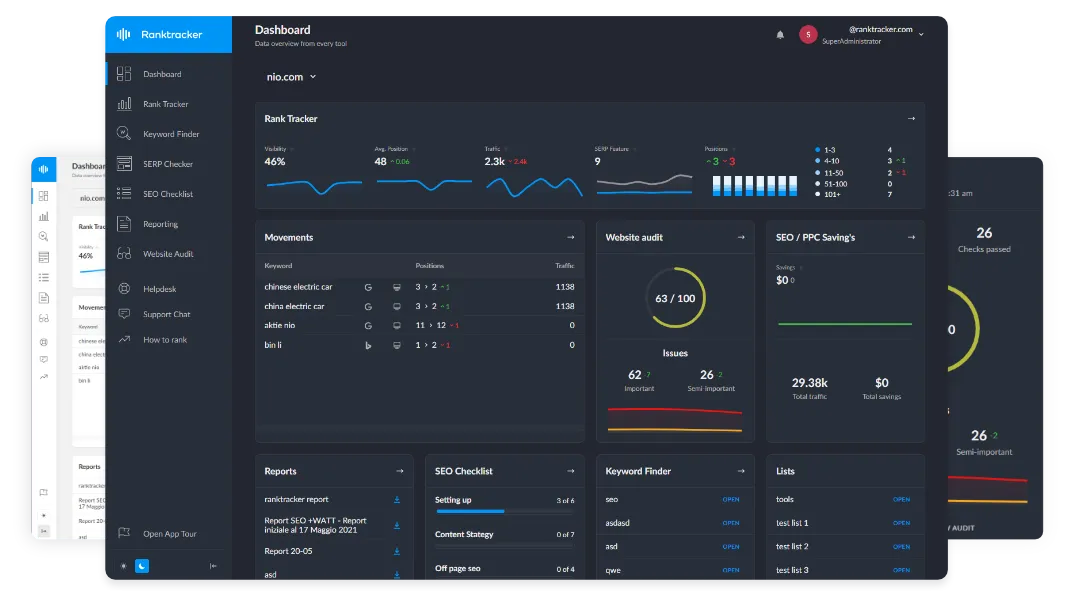
Some teams prefer to keep AI visibility reporting inside the same environment used for traditional SEO work. Several established SEO platforms have expanded in this direction. Ranktracker connects classic SEO signals with the emerging AI layer, allowing teams to monitor keyword rankings, SERP features and broader SEO performance while also tracking Google AI Overviews inside the same workflow. That matters because the pages, entities and third-party sources that answer engines rely on are often shaped by the same foundations SEO teams already work on: crawlability, topical authority, links, structured content and SERP presence.
Semrush brings AI visibility into one of the broadest digital marketing datasets available. Its AI Visibility Toolkit can benchmark brand visibility, track prompts and mentions, analyze competitors and connect AI-search observations to wider SEO and content workflows. SE Ranking has similarly expanded its platform with dedicated AI search tracking across Google AI Overviews, AI Mode, ChatGPT, Gemini and Perplexity, making it a practical choice for agencies that already rely on its SEO reporting and want to add AI visibility to client dashboards.
Enterprise AI Search Intelligence Platforms
Larger organizations with complex reporting requirements, multiple markets and cross-functional stakeholders often need more than lightweight prompt monitoring. Profound is aimed at this segment, functioning as an AI search intelligence platform useful for understanding how brands, products and topics are represented across answer engines at scale. Scrunch AI takes a governance-oriented approach, focusing on the broader relationship between brand information, the sources AI systems consume and the resulting answers users see. That is valuable for organizations where brand accuracy and cross-functional ownership matter as much as raw mention counts.
Content-Led GEO Platforms
Writesonic approaches generative engine optimization from a content-first direction. It combines AI-search monitoring with content creation and optimization workflows, making it particularly relevant to editorial and growth teams responsible for producing pages that can earn citations and recommendations. If creation and optimization are central to the use case, it can reduce the distance between insight and execution.
How to Choose the Right Platform for Your Team
Do not choose a platform only because it supports the largest number of models. Start with the questions your customers actually ask and the AI surfaces that can influence those decisions. Then evaluate whether the tool gives you enough evidence to change something.
- Choose a dedicated AI visibility platform if you mainly need prompt tracking, citations, competitors and source analysis.
- Choose an SEO suite with AI features if your team wants AI visibility beside rankings, SERP features, keyword research and technical SEO.
- Choose an enterprise intelligence platform if multiple markets, brand governance, reporting depth and cross-team workflows are the priority.
- Check how prompt usage is priced, because AI monitoring costs can grow quickly when you multiply prompts by models, locations and daily checks.
- Prioritize raw evidence over opaque scores, since the actual prompt, model answer, citation and competitor context are what make the data actionable.
Why SEO and AI Visibility Work Best Together
Traditional SEO and AEO should not be run as rival disciplines. A practical workflow starts with conventional search data to understand demand, rankings, authority and SERP competition, then adds AI monitoring to see how those same topics are being synthesized into answers. A team may use an SEO platform to identify a valuable keyword cluster, monitor organic movement and inspect the SERP, then use a dedicated AI visibility tracker to monitor the corresponding conversational prompts across multiple models, see which competitors are recommended and identify the external sources being cited. That combined view can reveal whether the next action is an on-site content improvement, a technical fix, a digital PR opportunity or a need to appear on a third-party comparison page. The goal is not to replace rank tracking but to expand search measurement so it reflects how discovery now works across both ranked results and generated answers.
Conclusion
AI visibility software is quickly becoming a standard part of the search marketer's toolkit. The right choice depends on whether you need an enterprise intelligence platform, a traditional SEO suite with AI features or a focused AI visibility tracker. Whichever platform you choose, the key question is no longer simply where your website ranks. It is whether the AI systems influencing your customers can find, trust, cite and recommend your brand — and whether your team has enough evidence to improve that outcome.