Intro
If you are researching Semrush Top 100 rank tracking, you may have seen this explanation from their team:
Position Tracking collects data daily, but after 60 days we compress historical data into weekly snapshots to keep the interface manageable.
That clarification helps, but it also reveals an important limitation.
Semrush does collect rankings daily, but you do not keep daily visibility long-term. After 60 days, daily data is no longer available. It is replaced with weekly points.
This article explains why that distinction matters and why many teams switch to Ranktracker once historical detail becomes important.
How Semrush Top 100 tracking actually works
Semrush Position Tracking works in two phases.
First 60 days
- Rankings are collected daily
- You can see day-by-day movements
- Full Top 100 depth is available
After 60 days
- Daily data is compressed
- Historical view switches to weekly snapshots
- Typically one data point per week
- Daily granularity is permanently lost
So while Semrush does daily tracking in the background, you cannot access daily Top 100 history beyond 60 days.
Why “daily tracking but weekly history” is still a problem
For ongoing SEO work, the difference is not academic. It is practical.
After two months, you lose the ability to:
- Review exact daily movements
- Diagnose short-term volatility
- Analyse the timing of wins and drops
- Correlate changes with links, content, or updates
- Revisit what actually happened during an algorithm shift
Weekly snapshots smooth out reality. They hide detail that matters later.
What this feels like in real SEO work
Most users notice the issue when they try to look back.
Common situations:
- A traffic drop happened six weeks ago and you want daily context
- A content change rolled out gradually but now looks instant
- A ranking spike appears as a single weekly jump
- Volatility around an update is impossible to reconstruct
The data was collected, but it is no longer visible.
Why Top 100 history matters long-term
SEO improvements do not always show immediate results.
Progress often looks like:
- Small daily gains
- Short reversals
- Gradual recovery
- Slow compounding improvement
When daily history is collapsed into weekly points, that story disappears.
The All-in-One Platform for Effective SEO
Behind every successful business is a strong SEO campaign. But with countless optimization tools and techniques out there to choose from, it can be hard to know where to start. Well, fear no more, cause I've got just the thing to help. Presenting the Ranktracker all-in-one platform for effective SEO
We have finally opened registration to Ranktracker absolutely free!
Create a free accountOr Sign in using your credentials
For agencies, in-house teams, and long projects, historical accuracy is just as important as freshness.
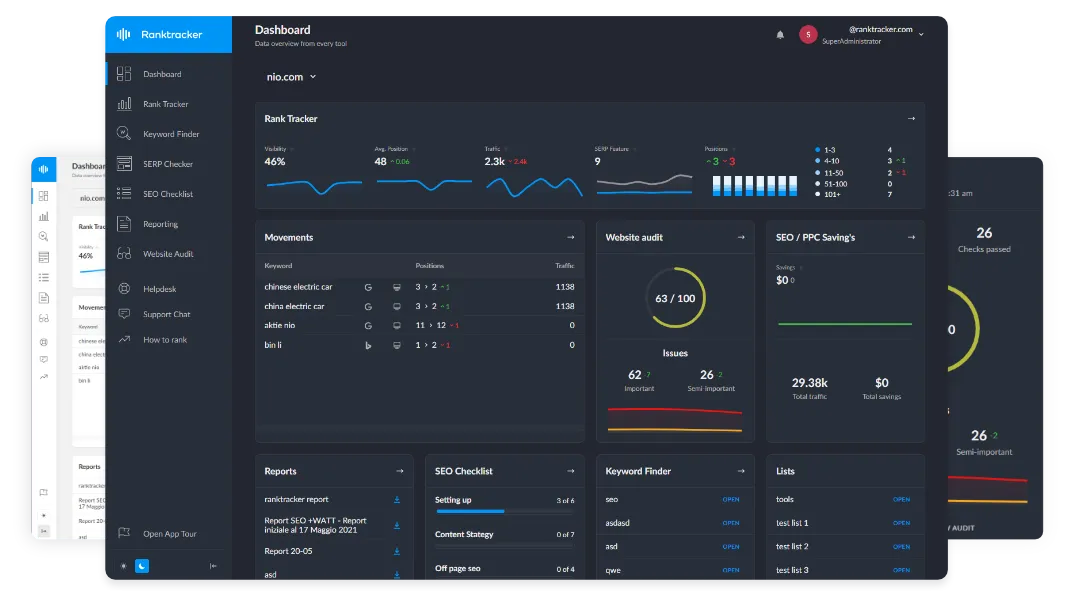
How Ranktracker handles Top 100 history
Ranktracker does not compress or discard daily data.
With Ranktracker:
- Top 100 rankings are tracked daily
- Daily history is preserved permanently
- No 60-day cut-off
- No weekly compression
- Full depth and full history for every keyword
If you want to see what happened 6 months ago, you still see daily movements. Nothing is smoothed away.
Semrush vs Ranktracker in simple terms
Semrush
- Daily tracking
- Daily history visible for 60 days
- Older data shown as weekly snapshots
- Long-term daily detail removed
Ranktracker
- Daily tracking
- Daily history kept forever
- Full Top 100 depth at all times
- No compression of older data
One prioritises interface simplicity. The other prioritises data integrity.
Why Semrush users start questioning rank tracking
Semrush users usually begin looking for alternatives when:
- They need to audit past ranking changes
- Weekly history feels too vague
- Algorithm analysis lacks precision
- Long-term SEO reporting loses detail
- Clients ask for daily timelines months later
At that point, missing historical granularity becomes a real problem.
Who Semrush rank tracking works best for
Semrush can work well if:
- You only care about recent changes
- Weekly historical views are acceptable
- Rank tracking is not mission-critical
But if your SEO depends on:
- Long-term diagnostics
- Daily timelines months later
- Accurate historical comparisons
- Full visibility across the Top 100 over time
Then compressed history becomes a limitation.
Bottom line
Semrush does track Top 100 rankings daily, but only shows daily history for the first 60 days. After that, historical data is reduced to weekly snapshots.
Ranktracker tracks the full Top 100 daily and keeps daily history permanently, with no compression and no cut-offs.
If you want long-term clarity, not just short-term freshness, daily Top 100 tracking needs to stay daily forever.