
Intro
Picture this. You’re planning a short weekend trip. You want a place that’s quiet, has good food, and won’t be packed with tourists.
Earlier, you’d open Google and type: “quiet weekend getaways near me” Then: “best time to visit X” Then: “hotels near X with good reviews”
You’d open a dozen links, skim blogs, scroll Reddit threads, and consolidate an answer yourself.
Now, you ask an AI assistant one thing: “Suggest a quiet weekend getaway within 4 hours of me, good food, not crowded this time of year.”
You get a single response: “Here are a few less-crowded destinations that fit your criteria.”
It lists options, along with the vibe of each place, things to do, how far they are from you, and what the food scene looks like. On the side, there’s a short list of links to hotel booking sites and TripAdvisor—there if you want them, easy to ignore if you don’t.
The All-in-One Platform for Effective SEO
Behind every successful business is a strong SEO campaign. But with countless optimization tools and techniques out there to choose from, it can be hard to know where to start. Well, fear no more, cause I've got just the thing to help. Presenting the Ranktracker all-in-one platform for effective SEO
We have finally opened registration to Ranktracker absolutely free!
Create a free accountOr Sign in using your credentials
Same intent. Fewer questions. One clear answer.
That’s how AI has changed search behavior and outcome. Thanks to Google’s AI overview and generative engines like ChatGPT and Perplexity, the way people ask questions and look for information feels so effortless. They don’t have to hunt for information anymore. They ask for outcomes.
If AI now influences how search engines interpret queries, rank content, and deliver results, how can SEO remain effective without using AI at all?
With AI SEO comes new ethical challenges.
In this blog, we’re going to cover the challenges and opportunities of ethics of AI in SEO, along with strategies for ethical AI in SEO.
What is AI SEO?
When businesses start exploring ai seo consultants, a common question pops up early: What is AI SEO?
AI SEO means using artificial intelligence across the SEO workflow, not only to optimize content for traditional search engines, but to stay citable in AI-powered discovery, search, and generative experiences.
The All-in-One Platform for Effective SEO
Behind every successful business is a strong SEO campaign. But with countless optimization tools and techniques out there to choose from, it can be hard to know where to start. Well, fear no more, cause I've got just the thing to help. Presenting the Ranktracker all-in-one platform for effective SEO
We have finally opened registration to Ranktracker absolutely free!
Create a free accountOr Sign in using your credentials
This includes two parallel shifts happening in the modern search landscape:
- Proliferation of AI tools that **automate and improve SEO. **
- Rise of Answer engine optimization and Generative engine optimization so AI systems recognize, trust, and surface it in answers, summaries, and recommendations.
In other words, the emphasis is no longer on just ranking #1 on a Google results page. It’s also about being the "source of truth" when an AI assistant answers a user’s question.
Why AI in SEO has become mandatory (not optional)
Search has become multi-dimentional. A new "visibility layer" across Large Language Models (LLMs) like ChatGPT, Claude, and Perplexity is now absorbing "top-of-funnel" informational searches. Users are far more interested in synthesized answers rather than clicking links.
Whether or not those AI interfaces drive immediate clicks is still an open question. But for brand awareness, and authority, not getting cited by AI is already a big disadvantage.
At the same time, discovery has fragmented. Reddit, Quora, TikTok, and YouTube have a direct role in research and purchase decisions. Google has noticed this, often filling its own search results with these platforms to keep up with user demand for "human-vetted" information. This pushes independent sites further down the page.
On top of that, discovery is no longer limited to search bars:
- Google Lens powers visual search.
- Meta AI is inside WhatsApp and Facebook.
- Google’s Gemini ecosystem is influencing how answers are generated.
- Tools like ChatGPT and Perplexity are becoming everyday research assistants.
- Users are also beginning to rely on personal AI agents.
The long and short of it is that–
Search visibility is increasingly mediated by machines, not just chosen by humans.
The result? When an LLM visitor finally lands on a website, they often arrive with more context, and more intent, than before—4.4 times as valuable as the average visit from traditional organic search, according to Semrush.
This means, SEO strategies built only for blue links and keyword repetition can’t fully accommodate this shift.
To stay effective, AI SEO has to work on two levels:
- Using AI to improve research, analysis, and execution—without outsourcing judgment.
- Organizing your content, entities, and trust signals in ways that help AI engines grasp its value and cite you without hesitation in their responses.
How can AI be used in SEO?
| SEO Function | The AI Application | The Strategic Advantage |
| Keyword research and intent analysis | Scans thousands of semantic variations and long-tail clusters in seconds using tools like Ubersuggest or SEMrush. | Surfaces "hidden" opportunities and untapped topic gaps that manual research often misses. |
| SEO strategy & planning | Processes large datasets across keywords, competitors, and SERPs | Evidence-backed SEO strategy |
| Content ideation and creation | Drafts outlines, blog posts, and meta descriptions via LLMs like GPT-4, Claude, and Jasper. | Accelerates production from weeks to hours; allows for rapid ideation and multiple content angles. |
| Technical SEO & audits | Uses AI algorithms to instantly find broken links, duplicate content, and crawl errors. | Replaces manual site crawls with automated, real-time health checks. |
| Link building & outreach | Analyzes backlink profiles and highlights link opportunities | Turns a manual "slog" into a targeted outreach strategy based on hard data. |
| Trend detection & forecasting | Machine learning spots emerging search patterns before they peak. | Allows you to build authority on a topic before the market becomes saturated. |
| Visual optimization | Generating images, SEO-friendly file names, and descriptive alt-text. | Boosts accessibility and image search visibility with zero manual effort. |
| Performance health | Detecting underperforming pages, content decay, and sudden ranking shifts. | Prevents "silent" traffic loss by flagging pages that need a refresh before they drop. |
What are the ethical concerns of using AI for SEO?
Despite being in its nascent stage, marketers are already going big on AI powered SEO for its undeniable efficiency. But when AI SEO deployed without guardrails introduces serious ethical risks that not too many marketers are thinking about at this stage.
Here are the primary ethical boundaries currently under pressure for AI SEO best practices:
1. AI-generated content and the authenticity problem
AI can produce content at speed and volume at warp speed. But the problem is it’s often produced for algorithms first, and human second.
Using AI for "Scaled Content Abuse" (churning out thousands of low-value pages), keyword stuffing, or "cloaking" (showing different content to bots than to humans) are among unethical practices that marketers should want to avoid.
These tactics are no longer just "shady"; they are primary targets for Google’s spam updates. Because without the human factor, AI-generated content can become quite the opposite of helpful content. It can:
- Look confident while being factually wrong.
- Flatten nuance and experience into surface-level, regurgitated explanations.
- Create the illusion of expertise without accountability.
So, is it ethical to use AI-generated content for SEO?
Google answers: AI-generated content is allowed if it’s helpful, accurate, and trustworthy. What crosses the line is using AI to mass-produce content purely to manipulate rankings and pushing out content that lacks human validation.
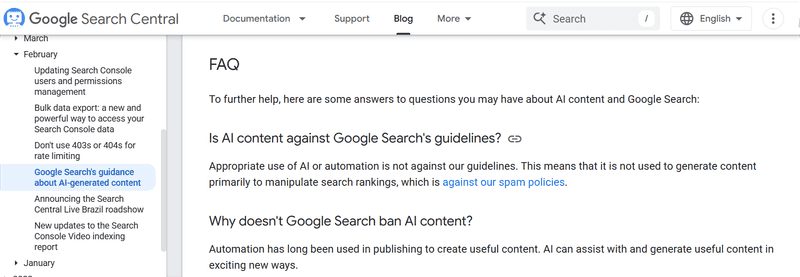
Image Source: Google Search Central
2. Misinformation and hallucinations
Perhaps the most dangerous ethical risk is AI’s tendency to "hallucinate". Hallucination means presenting false information like an “all-knowing” expert. It makes AI notoriously capable of generating content that sounds plausible but is far from true.
For example, If a brand publishes unverified AI content that leads a user to make a poor financial or medical decision, the brand is ethically (and potentially legally) liable.
In AI SEO, this creates a serious ethical risk:
- Incorrect facts published as authority.
- Outdated information presented as current.
- Chatbot-generated explanations that mislead users.
Even when unintentional, publishing inaccurate information such as fake reviews, misleading "how-to" guides, or false product claims. This breaks user trust because if AI content is surfaced in generative answers, your brand becomes responsible for the mistake, not the model.
3. Plagiarism and content ownership traps
Generative AI models don’t inherently “know” things. They’re trained on massive datasets of existing human work. Because they function by predicting the next likely word, they can accidently scoop up unique phrases, proprietary ideas, or specific creative structures from their training material without clear attribution to the creators.
Ann Handley writes on her blog:
"Meta trained its AI on all three of my books—plus millions of other books, ebooks, and research papers. No consent. No compensation. No copyright consideration. No credit. You only discover this by searching a database The Atlantic published days ago. They deliberately chose to take the books rather than pursue proper legal channels, because the legitimate route was too slow.
The real problem? We're normalizing intellectual property theft on an absurd scale."
For SEO teams, this raises concerns around ethics of AI in SEO:
- Unintentional plagiarism.
- Copyright infringement.
SEO specialists into ethical AI SEO practice must ensure that AI outputs are vetted for originality and that external sources are credited, rather than letting the machine "borrow" intellectual property.
4. Data privacy
Data has always been the cornerstone for SEO. But the fineness that comes with AI-driven analysis is something else. AI can comb through user behavior patterns deeply. Sometimes, creepily deep that it exposes individual anonymity by poorly handling sensitive information.
How to draw the line in using AI ethically in SEO
1. Get human oversight
The most important ethical guardrail is ensuring that no AI output is ever the "final" product.
- For topics involving health, finance, or legal advice, have a firm stance on having only human-written content. If you must use AI, ask it to work with you, not for you. It can help with research, but the expertise must be human.
- While AI is working like a highly capable intern, brainstorming, outline, and summarizing, a human expert must assess every claim for "hallucinations".
- Don’t boycott AI but have a mandatory fact-checking workflow in SEO. If an AI cites a study, someone from your team must be assigned to verify that the study actually exists and hasn't been misinterpreted.
2. Double Down on E-E-A-T
Google’s search quality standards (Experience, Expertise, Authoritativeness, and Trustworthiness) are the ultimate antidote to low-quality AI content.
Don’t exploit AI without innovating. AI has knowledge, but it doesn't have "life." Use AI to structure your post, then manually add real-world case studies, personal anecdotes, and original photos that signals that you’re the creator of this work.
Also, attach content to real, identifiable, attributable experts. It gives readers and search bots another level of trust that only comes from backing by a person with a verifiable track record in that niche.
- Establish governance and disclosure
It’s not too much to ask for transparency if you want ethical AI practices in SEO. In fact, the issue isn't AI itself or that it learns from human knowledge. The issue is the method—training without disclosure.
Agencies and brands should have a clear "AI Manifesto" or Internal Policy:
- Be honest about your process. If a blog was "AI-assisted but human-edited," add a disclosure. It gives you room to build long-term trust and protect you if the AI's "training data" is ever called into question.
- Never feed proprietary, confidential, or client-sensitive information into public LLMs like ChatGPT.
- Run your content through tools like Copyscape to catch bits that AI might have pulled from proprietary language from other creators.
4. Avoid bias and inaccuracy
Ethical SEO requires auditing the "black box" of your tools as rigorously as your final content. LLMs are not objective; they mirror their training data. Because the internet isn't always fair, AI often learns and repeats stereotypes.
Example: Imagine you’re using AI to write a blog about "successful CEOs." If the AI only suggests examples of men in their 50s, it’s ignoring reality. An expert catches this and manually adds diverse examples to ensure the content is accurate and inclusive. If you don't check, your brand looks out of touch.
Furthermore, data vetting is a strategic necessity,too. Before integrating any tool, you must confirm that your inputs are explicitly excluded from the model’s training loop. If you aren't paying for a "zero-retention" privacy tier, your proprietary keyword strategies and internal data are likely becoming the training fodder for your competitors’ future prompts.
FAQs
At what point does AI content become spam?
AI content turns into spam when it is written for the algorithm alone and stops serving a human reader. Think about all those pages you must have come across that say a lot but have a very little susbstance—thin summaries, recycled ideas, or content created purely to fill a keyword gap.
If you’re mass-producing 50 pages a day just to "own" a cluster of keywords, without checking if the content is helpful or if the formatting is readable, you’ve crossed the line.
How do you scale content ethically with AI?
You don’t scale writing with AI, you scale the work around writing.
The All-in-One Platform for Effective SEO
Behind every successful business is a strong SEO campaign. But with countless optimization tools and techniques out there to choose from, it can be hard to know where to start. Well, fear no more, cause I've got just the thing to help. Presenting the Ranktracker all-in-one platform for effective SEO
We have finally opened registration to Ranktracker absolutely free!
Create a free accountOr Sign in using your credentials
AI can help with research, outlines, content audits, internal linking ideas, and identifying gaps worth covering. The actual thinking, judgment, and final narrative has to be from humans. Ethical scaling means producing more useful content without lowering the bar on quality or originality. The "ethical" part comes from taking responsibility for the output. If the AI hallucinates a fact and you publish it, the onus is on you.
Does AI-written content kill E-E-A-T?
By itself? Yes. AI hasn't lived through anything. It's never tested a product, experienced a problem, or navigated a real professional challenge.
Yet, AI-assisted content can still meet E-E-A-T standards when a credible expert shapes, refines, and stands behind it. This means adding original case studies, personal insights, and a verified author byline.
Can AI-written articles rank without violating Google’s rules?
Absolutely. Google has been very clear: they don’t care how the content is produced as long as it’s high-quality and helpful. What gets penalized is content that misleads, offers little substance, or gets churned out in bulk with no human judgment involved.
AI-written articles can rank when they're factually sound, help in Information gain, get scrutinized by human eyes, and meet user intent.
You don’t "break the rules" for having ChatGPT or Claude to help you write. You only violate guidelines when you use those tools for "scaled content abuse"