Intro
The AI search landscape has fundamentally changed how brands need to think about visibility. With users increasingly turning to ChatGPT, Claude, Perplexity, and Google AI Overviews for answers, monitoring your brand’s presence across these AI chat platforms is now a baseline requirement for any serious SEO and marketing strategy.
Peec AI entered this space as a basic LLM tracking tool focused on brand monitoring in AI-generated responses. For some teams, that’s enough to get started. But many marketers and SEO professionals quickly discover that Peec AI’s limited feature set, high pricing, and lack of critical capabilities like prompt research, share of voice depth, and unified SEO integration create major gaps once you try to scale AI visibility into a repeatable channel.
If you’re looking for a more comprehensive solution for AI tracking and brand monitoring, you’re not alone. In this guide, you’ll find the best Peec AI alternatives in 2026 — tools that offer fuller AI tracking functionality, better value, and the visibility (and action layer) you need to actually win in AI-assisted discovery.
Why Look for Peec AI Alternatives?
Peec AI has carved out a niche in the AI monitoring space, but it comes with limitations that push growth-focused teams to explore other options. The biggest reasons usually fall into five categories: coverage, capability, scalability, workflow, and ROI.
Limited feature coverage
Peec AI primarily focuses on basic LLM visibility tracking — whether a brand appears in AI-generated answers and some lightweight monitoring. That’s useful, but it often isn’t enough.
In practice, modern AI answers are shaped by multiple layers:
- prompts and user intent (what the user asks and how they phrase it)
- model behavior (how the assistant interprets and structures the answer)
- sources/citations (what pages, brands, and domains the AI relies on)
- classic SEO signals (rankings, authority, topical depth, structured content)
- market factors (country, language, location, industry norms)
A tool that only monitors the final “answer layer” leaves you blind to the inputs you need to influence outcomes.
High pricing for a narrower tool
A recurring complaint about Peec AI is pricing relative to feature depth. Paying premium pricing for a tool that does “basic monitoring” becomes difficult to justify when alternatives provide more comprehensive workflows (especially when they combine AI visibility with classic SEO rank tracking and competitor intelligence).
In 2026, the best-performing teams don’t want yet another standalone dashboard. They want one system that connects AI visibility to the levers that improve it.
No free trial
Peec AI’s lack of a free trial creates friction. AI visibility tools are not “one-size-fits-all.” Teams need to validate:
- whether the platform tracks the prompts they care about
- whether it supports their markets and languages
- whether the reporting cadence fits their workflow
- whether insights lead to action
Without a trial, teams take on risk before they can confirm fit.
Missing or shallow share of voice analytics
Share of voice is the real metric of AI discovery.
It answers: “How often does AI recommend us compared to competitors — across the prompts that drive purchase decisions?”
The All-in-One Platform for Effective SEO
Behind every successful business is a strong SEO campaign. But with countless optimization tools and techniques out there to choose from, it can be hard to know where to start. Well, fear no more, cause I've got just the thing to help. Presenting the Ranktracker all-in-one platform for effective SEO
We have finally opened registration to Ranktracker absolutely free!
Create a free accountOr Sign in using your credentials
If you can’t break down share of voice by prompt cluster, intent type, market, and competitor overlap, you end up with vanity metrics.
Limited prompt research and discovery
Prompt research is the equivalent of keyword research for AI search.
If your tool can’t help you discover:
- high-intent prompts you’re missing
- alternative/migration prompts (“Peec AI alternative,” “switch from X to Y”)
- comparison prompts (“X vs Y for agencies”)
- category prompts (“best AI visibility tool for SaaS”)
- use-case prompts (“AI monitoring for eCommerce SEO”)
…then you’re only monitoring the small slice of demand you guessed correctly.
That is not a strategy. It’s partial visibility.
What to Look for in a Peec AI Alternative
Before we list tools, it helps to define what a “real” alternative should include in 2026.
Complete LLM tracking across major platforms
At minimum, you want visibility across:
- ChatGPT
- Google AI Overviews
- Perplexity
- Claude
- Gemini (and related Google AI search experiences)
If coverage is partial, you’ll build strategy on incomplete data.
Advanced prompt research and discovery
Look for platforms that support:
- prompt libraries and templates by intent type
- clustering (grouping similar prompts into themes)
- competitor mapping per cluster
- prompt trend detection over time
- custom prompt creation at scale
This is how you build repeatable growth from AI monitoring rather than one-off reporting.
Citation intelligence and source attribution
The “why” behind AI mentions matters as much as the “whether.”
A strong alternative should track:
- which domains/pages are cited
- citation frequency across prompt sets
- competitor citation overlap (who owns the sources you want)
- recurring source patterns (which publications dominate your category)
- content gaps (what topics exist in cited sources but not in yours)
Without citation intelligence, you can’t systematically win AI visibility.
Share of voice metrics that actually guide strategy
Share of voice should be measurable by:
- prompt cluster
- funnel stage (TOFU, MOFU, BOFU)
- market/location
- competitor set
- time period (trend and change after optimization)
That’s how you connect AI monitoring to weekly/monthly execution.
Traditional SEO integration
This is the big one.
AI visibility is strongly correlated with classic SEO signals:
- rankings (including volatility)
- content depth and topical authority
- technical health
- internal linking and site architecture
- SERP feature ownership
- backlink profile
Tools that combine AI tracking with rank tracking and SERP intelligence give you control, not just observation.
Scalable pricing and reporting
You want:
- gradual scaling tiers
- predictable usage metrics
- reporting that works for teams and agencies
- exports or API options (depending on your workflow)
If pricing forces you to cap prompts or markets early, you’ll stall before the channel pays off.
Best Peec AI Alternatives for AI Tracking in 2026
Based on feature depth, workflow value, and suitability for ongoing monitoring (not just “testing”), here are the top Peec AI alternatives:
- Ranktracker – Best overall for AI tracking + SEO execution in one platform
- Nightwatch – Strong monitoring foundation with AI visibility capabilities
- Otterly AI – Focused AI visibility monitoring with share-of-voice concepts
- Knowatoa AI – Brand characterization monitoring and alerts
- Scrunch AI – Brand narrative accuracy and knowledge hub workflows
- Profound AI – Enterprise reporting for AI visibility (costly, reporting-led)
- Rankscale AI – AI-focused audits and optimization diagnostics
(Keyword.com can also be relevant for certain agency stacks, but the core “best seven” are above.)
Now let’s break each one down in detail.
1. Ranktracker (Best Overall Peec AI Alternative)
The All-in-One Platform for Effective SEO
Behind every successful business is a strong SEO campaign. But with countless optimization tools and techniques out there to choose from, it can be hard to know where to start. Well, fear no more, cause I've got just the thing to help. Presenting the Ranktracker all-in-one platform for effective SEO
We have finally opened registration to Ranktracker absolutely free!
Create a free accountOr Sign in using your credentials
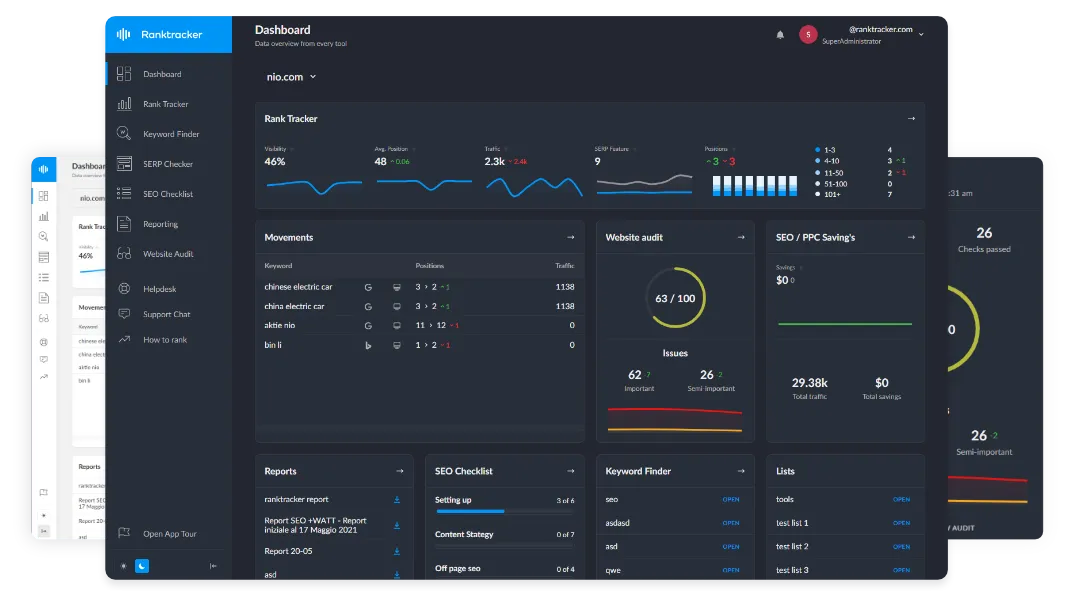
If Peec AI is “basic AI mention tracking,” Ranktracker is what you use when you want AI visibility to become a growth channel you can control.
The core difference is workflow.
Peec AI mostly tells you what AI says.
Ranktracker helps you understand why AI is (or isn’t) surfacing your brand — and gives you the SEO and SERP tools to change it.
Why Ranktracker is the strongest upgrade
AI systems don’t invent recommendations from nothing. They draw heavily from:
- authoritative sources
- well-structured content
- domains that demonstrate topical depth
- pages that already perform well in classic search
- consensus signals across the web
So the teams that win AI visibility do two things consistently:
- Monitor AI presence and competitor share of voice
- Improve the SEO inputs that increase citation probability
Ranktracker supports both in one environment.
What you get with Ranktracker
A unified platform that includes:
- AI visibility monitoring across major AI environments
- daily rank tracking
- deep SERP tracking up to the top 100
- SERP feature monitoring
- keyword discovery workflows
- competitor tracking and visibility comparisons
- share-of-voice reporting
- technical site auditing
That matters because AI visibility is not a standalone metric. It is connected to rankings, authority, and topical coverage.
Deep SERP tracking is a hidden advantage
Many teams assume AI only pulls from top 3 results.
In reality, AI answers often synthesize across multiple sources, and those sources can include pages outside the top 3 (or even outside the top 10), especially for:
- broad “best tools” queries
- research prompts
- how-to prompts
- category definitions
- comparisons and “alternatives” prompts
If you only track top 10, you miss early signals.
Tracking to top 100 gives you:
- early opportunity detection
- competitor movement visibility before they hit top 10
- content gap mapping based on “who is rising”
- stronger context for why AI is citing certain pages
Share of voice becomes your AI KPI
In AI search, the user often receives a shortlist.
So the real metric is:
“How often are we included in the shortlist compared to competitors?”
Ranktracker’s share-of-voice framing helps you treat AI visibility like competitive market presence rather than random mentions.
Best for
Ranktracker is best for:
- SEO teams that want AI tracking tied directly to ranking control
- agencies that need a unified client reporting workflow
- SaaS brands competing on “alternatives,” “vs,” and “best for” prompts
- teams scaling internationally and needing deep segmentation
If you want an actual “control center” for AI and SEO visibility, Ranktracker is the clearest upgrade from Peec AI.
2. Nightwatch (Strong monitoring foundation)
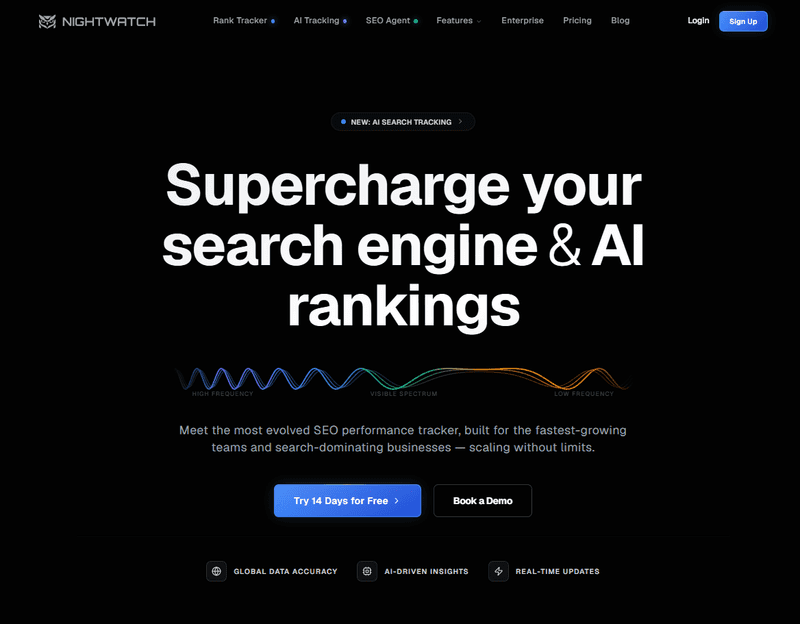
Nightwatch is known for reliable tracking workflows and reporting. For teams that want a monitoring-first platform and are layering AI visibility into an existing search workflow, it can be a strong Peec alternative.
Strengths
- mature monitoring UX
- strong reporting capabilities
- useful for teams and agencies managing multiple projects
- good foundation for ongoing visibility checks
Limitations
- AI depth and prompt research sophistication can vary
- may not provide the same unified “AI + SEO execution” loop as a full ecosystem
Best for
Nightwatch is best for teams that want a dependable monitoring platform, especially if they already value its SEO tracking workflows.
3. Otterly AI (Focused AI visibility tracking)
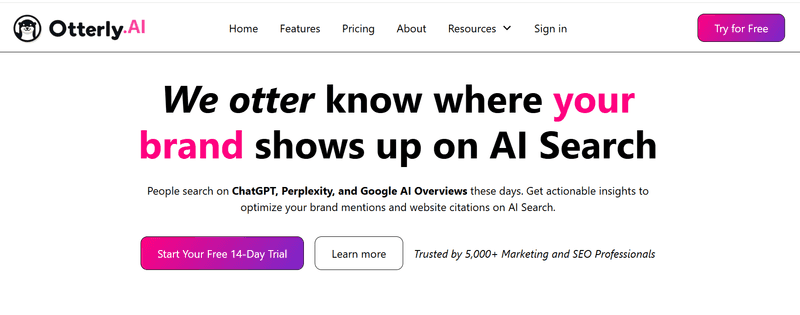
Otterly AI remains a relevant alternative because it’s specifically built around AI visibility monitoring and share-of-voice concepts.
If you want to stay inside an AI-only tool, Otterly can work.
Strengths
- AI monitoring focus
- share-of-voice concepts for competitive framing
- clean, accessible dashboards for marketing teams
Limitations
- lacks full SEO execution tooling
- prompt research can be limited compared to advanced platforms
- scaling costs can become substantial at higher tiers
Best for
Otterly is best for marketing teams who want AI visibility monitoring as a standalone function and already have a separate SEO stack.
4. Knowatoa AI (Sentiment and misrepresentation monitoring)
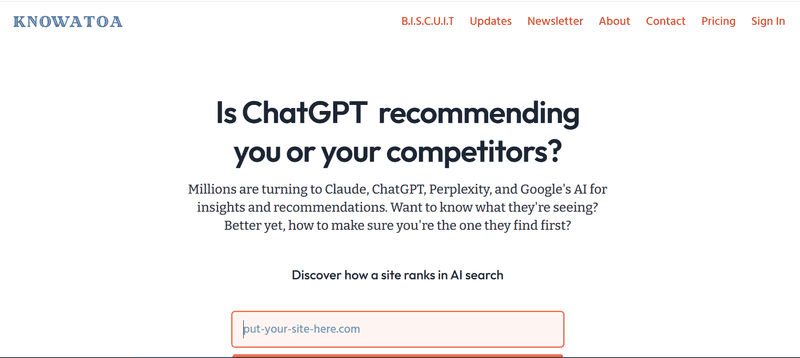
Knowatoa’s positioning is about brand characterization: how AI describes you, and whether those descriptions are accurate.
This matters when AI answers can influence perception at the exact moment users compare vendors.
Strengths
- alert-driven monitoring for misrepresentation
- sentiment and framing visibility
- useful competitive benchmarking
Limitations
- may not provide deep citation-level optimization workflows
- limited classic SEO integration relative to unified platforms
Best for
Knowatoa is best for teams worried about AI misinformation, inaccurate brand descriptions, and perception risk.
5. Scrunch AI (Brand narrative control)
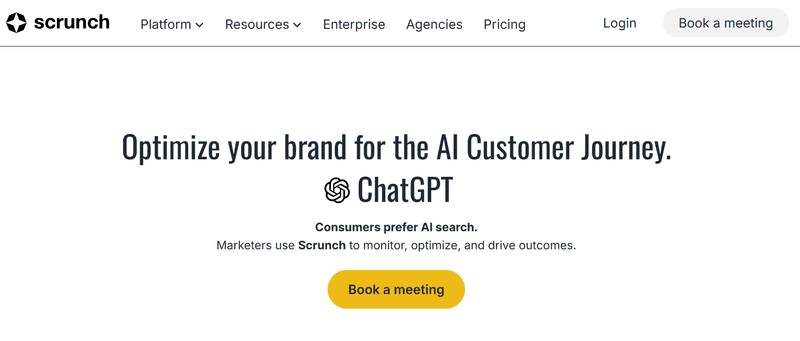
Scrunch leans into brand narrative accuracy.
If your concern is: “AI is telling the wrong story about us,” Scrunch can be useful.
Strengths
- emphasis on brand messaging alignment
- workflows that highlight inaccurate or outdated representation
- marketing-oriented insights
Limitations
- expensive relative to prompt volume for many teams
- less “performance SEO execution” focus
- not always designed as a unified SEO control center
Best for
Scrunch is best for enterprise marketing teams prioritizing narrative control and accuracy.
6. Profound AI (Enterprise reporting)
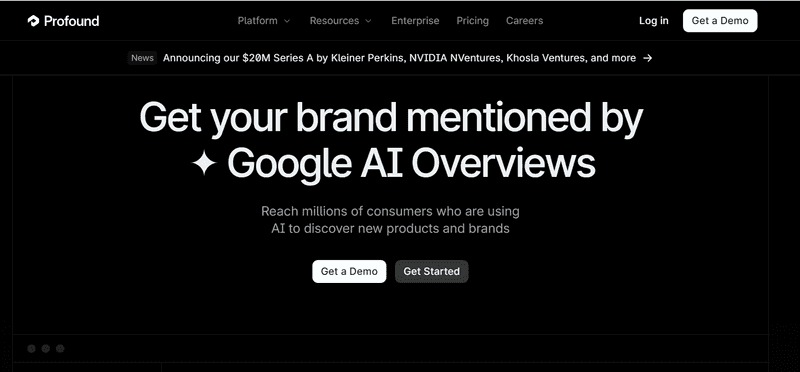
Profound AI is typically positioned for enterprise visibility reporting.
Strengths
- executive dashboards
- enterprise-style monitoring
Limitations
- expensive for what many teams consider “surface-level reporting”
- often less actionable than performance-focused platforms
Best for
Profound is best for large organizations that primarily need leadership-level reporting rather than execution workflows.
7. Rankscale AI (AI audits and diagnostics)
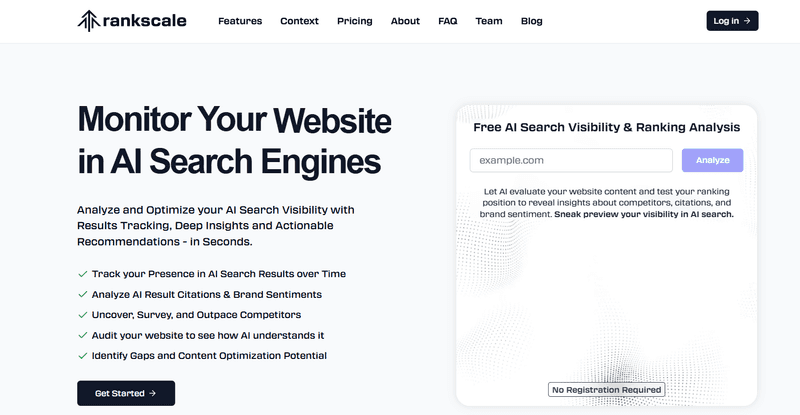
Rankscale is best thought of as an “AI optimization diagnostics” platform.
Instead of focusing only on mention tracking, it leans into:
- audits
- content recommendations
- identifying issues that block AI visibility
Strengths
- useful AI-focused audits
- content optimization suggestions
- good for teams that want guidance on what to improve
Limitations
- credit-based usage can limit continuous monitoring
- narrower monitoring scope than all-in-one platforms
Best for
Rankscale is best for teams experimenting with AI-specific content optimization and audit workflows.
How to Choose the Right Peec AI Alternative
Here’s the simplest way to decide.
If you want AI visibility to drive pipeline growth
You need a platform that ties AI monitoring to SEO execution and competitive SERP intelligence.
That’s why Ranktracker is #1.
It doesn’t just tell you whether you’re visible — it connects visibility to the actions that increase it.
If you just want a standalone AI monitoring tool
Otterly AI can work if you already have a full SEO stack elsewhere and you’re comfortable with a dedicated AI monitoring tool.
If you care most about perception and narrative risk
Knowatoa and Scrunch are better fits when accuracy, framing, and misrepresentation are the primary concern.
If you need enterprise dashboards
Profound can fit, but you’ll want to confirm that it matches your “action needs,” not just reporting needs.
If you want audit-style guidance for AI optimization
Rankscale can help, especially as a diagnostic layer.
Frequently Asked Questions
How does AI tracking differ from traditional SEO rank tracking?
Traditional rank tracking measures where your pages appear in search results for a keyword.
AI tracking measures whether and how AI systems include your brand inside answers. You’re measuring:
- mention frequency
- share of voice versus competitors
- citations and sources
- sentiment and framing
- visibility by prompt cluster and intent type
Rank tracking = positions. AI tracking = conversational inclusion and influence.
Can AI tracking tools help improve visibility in ChatGPT?
Yes, indirectly.
They help you identify:
- prompts where competitors dominate
- topics and content gaps
- source patterns that AI models prefer
- negative framing or inaccurate descriptions
Then your team improves visibility through execution: better content, stronger authority signals, improved technical SEO, and structured topical coverage.
Why is prompt research so important?
Because prompts are demand.
The All-in-One Platform for Effective SEO
Behind every successful business is a strong SEO campaign. But with countless optimization tools and techniques out there to choose from, it can be hard to know where to start. Well, fear no more, cause I've got just the thing to help. Presenting the Ranktracker all-in-one platform for effective SEO
We have finally opened registration to Ranktracker absolutely free!
Create a free accountOr Sign in using your credentials
If you’re not tracking the prompts users actually ask, you’re measuring visibility against the wrong market.
Prompt research helps you find:
- high-intent “best” and “alternative” prompts
- comparison prompts
- migration prompts
- use-case prompts by persona and industry
Which AI platforms should I monitor?
For most teams, prioritize:
- ChatGPT
- Google AI Overviews
- Perplexity
Then expand to Claude and Gemini based on audience and market.
Final Take
Peec AI can be a starting point for basic LLM visibility tracking, but most serious teams outgrow it quickly due to pricing and limited strategic depth.
In 2026, the winning approach isn’t just monitoring what AI says — it’s building a workflow that connects AI visibility to the SEO inputs that determine whether you’re cited and recommended.
That’s why Ranktracker is the best Peec AI alternative overall: it combines AI monitoring with rank tracking, deep SERP intelligence, share of voice, and the execution layer required to actually improve results.