Intro
I’ve spent years obsessing over keyword rankings — watching pages climb to that sweet #1 spot on Google. And for a long time, that was the game. Rankings meant traffic. Traffic meant leads. Leads meant revenue. Simple enough.
But people aren’t searching the way they used to.
They’re asking ChatGPT what tools to buy. They’re using Perplexity to compare products. They’re scanning Google’s AI Overviews and deciding without ever clicking through. And if you’ve checked your own brand in those AI answers and felt that sinking “wait… we’re not even mentioned” moment, you’re not alone.
That’s exactly why AI search monitoring tools exist.
They help you measure brand visibility across AI answer engines the same way classic SEO tools measured your Google rankings — except the KPI is no longer “position 3,” it’s “do we exist in the answer at all, and how are we being framed?”
This guide walks through the best AI search monitoring tools for marketers in 2026. Some are simple and affordable. Some are enterprise-grade. But the best ones all solve the same core problem:
- They show you where you’re visible (or invisible) inside AI-generated answers
- They reveal who AI recommends instead of you
- They uncover what sources drive those recommendations
- They help you improve your presence where buying decisions are happening now
Let’s get into it.
What Are AI Search Monitoring Tools and Why They Matter
AI search monitoring tools track how your brand appears inside AI-powered discovery experiences — including ChatGPT-style assistants, “answer engines” like Perplexity, and Google AI Overviews.
The All-in-One Platform for Effective SEO
Behind every successful business is a strong SEO campaign. But with countless optimization tools and techniques out there to choose from, it can be hard to know where to start. Well, fear no more, cause I've got just the thing to help. Presenting the Ranktracker all-in-one platform for effective SEO
We have finally opened registration to Ranktracker absolutely free!
Create a free accountOr Sign in using your credentials
Traditional SEO is built around keywords, rankings, backlinks, click-through rates, and organic sessions.
AI search visibility is built around a different set of realities:
- LLMs summarize instead of list
- Users trust the assistant’s shortlist
- Citations and “trusted sources” influence which brands get included
- Mentions often happen with no click at all
- The framing of the mention matters as much as the mention itself
So if classic SEO tools told you where you ranked, AI monitoring tools tell you whether you’re recommended, cited, or ignored.
And there’s a brutal twist here:
You can be doing “fine” in classic SEO and still be nearly invisible in AI answers.
I’ve seen brands with strong organic traffic and stable rankings get completely shut out of AI-generated recommendations. Search Console looks healthy. Rankings look fine. But in the place where buyers actually ask “what should I use?”, the brand is missing.
That gap is where AI search monitoring creates real value — because you can’t fix what you can’t measure.
Why it matters more than most marketers expect
AI search isn’t just another “channel.”
The All-in-One Platform for Effective SEO
Behind every successful business is a strong SEO campaign. But with countless optimization tools and techniques out there to choose from, it can be hard to know where to start. Well, fear no more, cause I've got just the thing to help. Presenting the Ranktracker all-in-one platform for effective SEO
We have finally opened registration to Ranktracker absolutely free!
Create a free accountOr Sign in using your credentials
It’s compressing the buyer journey.
In the old world, the buyer did the comparison work. They visited five sites, read reviews, checked pricing pages, and made a decision.
In AI search, the assistant does that work for them.
It summarizes the category, selects a shortlist, and often makes a recommendation based on “common consensus” sources. If you’re not included, you don’t just lose one click — you lose the entire consideration phase.
Here’s what’s happening in real marketing terms:
- AI responses influence perception before your website is even seen.
Brands are already dealing with situations where AI describes them as “expensive,” “only for enterprises,” or “hard to use,” even when that’s not the story they want told.
- Zero-click is becoming the default.
Even if your content ranks, the user might get enough info in AI Overviews or a Perplexity answer to decide without clicking.
- AI visibility becomes a compounding advantage.
Brands that get consistently cited and recommended build authority signals. That can reinforce classic SEO over time as more people search for them directly, talk about them, and link to them.
This is why AI search monitoring is becoming what SEO audits were in the early days: a foundation.
If you don’t measure it, you can’t improve it — and your competitors absolutely will.
The Essential Features in an AI Search Monitoring Tool
Most tools look similar on the surface: dashboards, prompts, mention counts, charts.
But what matters is the depth of what they track and how actionable it is.
Here are the features that separate a “nice report” from a tool that actually helps you win.
Multi-platform coverage
If a tool only monitors one environment, it’s not giving you reality — it’s giving you a slice.
In 2026, you want monitoring across the platforms that shape buying decisions:
- ChatGPT-type assistants
- Google AI Overviews
- Perplexity-style “answer engines”
- Claude and other research assistants
- Gemini-powered experiences (depending on your market)
Different platforms behave differently. Some cite sources heavily. Some summarize more. Some are more conservative about recommending brands. If your tool doesn’t cover the platforms your audience uses, your insights will be skewed.
Prompt tracking and discovery
Prompts are the new keywords.
But unlike keywords, prompts vary wildly in phrasing.
Two prompts can be “the same intent” but worded totally differently:
- “best AI search monitoring tool for marketers”
- “how do I track brand mentions in AI answers?”
- “what tools monitor google ai overviews and chatgpt?”
- “otterly alternative for agencies”
- “how do i improve my visibility in ai recommendations?”
The best tools help you do more than track prompts you already thought of.
They help you discover:
- high-intent prompt clusters you’re missing
- “alternatives” and “vs” prompts that drive migrations
- buyer-stage prompts (awareness vs evaluation vs purchase)
- industry-specific prompt patterns
If you don’t have prompt discovery, you’re measuring a small portion of demand.
Competitor benchmarking and share of voice
AI answers are competitive.
If the assistant recommends three vendors and you’re not one of them, you’re losing share of voice.
So you need competitive benchmarking that answers questions like:
- Who shows up when we don’t?
- Which competitor dominates which prompt cluster?
- Are we losing “best for X” prompts but winning “how to” prompts?
- How does our share of voice shift month over month?
Mention counts alone aren’t enough. You want visibility relative to competitors, across prompt clusters, over time.
Citation and source tracking
Most AI answers are shaped by what the model “trusts.”
Even when there’s no direct link, the assistant often pulls from sources:
- review sites
- category guides
- authoritative blogs
- documentation
- Wikipedia-style references
- forums and communities (sometimes)
If you can’t see what sources are being used, you can’t reverse engineer how to win.
Citation tracking tells you:
- which pages get cited repeatedly
- which domains dominate your category
- where competitors are winning citations
- what content formats AI prefers (guides, comparisons, definitions, etc.)
This is where AI monitoring becomes strategic instead of just observational.
Sentiment and framing analysis
Sentiment isn’t just “positive” or “negative.”
In AI answers, framing matters:
- Are you framed as the premium option?
- Are you framed as the budget alternative?
- Are you framed as “best for beginners” but not trusted for enterprise?
- Are your limitations overemphasized?
- Is AI repeating outdated claims about your product?
The goal isn’t just being mentioned. It’s being positioned correctly.
Alerts and change detection
AI answers can change.
A small update to a model or a shift in the sources it relies on can alter the answer.
So your tool should support:
- daily tracking (minimum)
- alerts when share of voice changes
- notifications when sentiment shifts
- detection of new sources/citations entering the answer set
Otherwise you’ll only notice changes after the damage is already done.
SEO integration (the “unfair advantage” feature)
This is the big differentiator.
AI visibility is tightly connected to classic search signals:
- rankings
- topical authority
- content depth
- backlinks and trust signals
- structured content
If your AI monitoring tool lives separately from your SEO workflow, you get stuck:
- you see the outcome
- but you can’t connect it to the inputs you control
The best setups unify AI monitoring and SEO execution so you can identify:
- which pages should be improved
- which topics should be covered deeper
- which SERP features correlate with AI citations
- which competitors are winning in both SEO and AI discovery
For marketers who want results (not just reporting), SEO integration is the difference between tracking a problem and fixing it.
The Best AI Search Monitoring Tools for Marketers in 2026
I’ve tested most of the AI search monitoring tools in this space, and the options have improved fast. But not all of them are equally useful for marketers.
Some are pure monitoring tools. Some are brand perception tools. Some are enterprise dashboards. A few are actually built to support ongoing optimization.
Here are the tools that matter most in 2026 — and what each one is best at:
- Ranktracker
- Nightwatch
- Otterly AI
- Knowatoa AI
- Scrunch AI
- Profound AI
- Peec AI
I’m including both “feature-rich” and “simple” tools, because the best tool depends on your team maturity. But if you’re building AI visibility as an acquisition channel, you’ll want the tools higher on this list.
Let’s break down each one.
1) Ranktracker
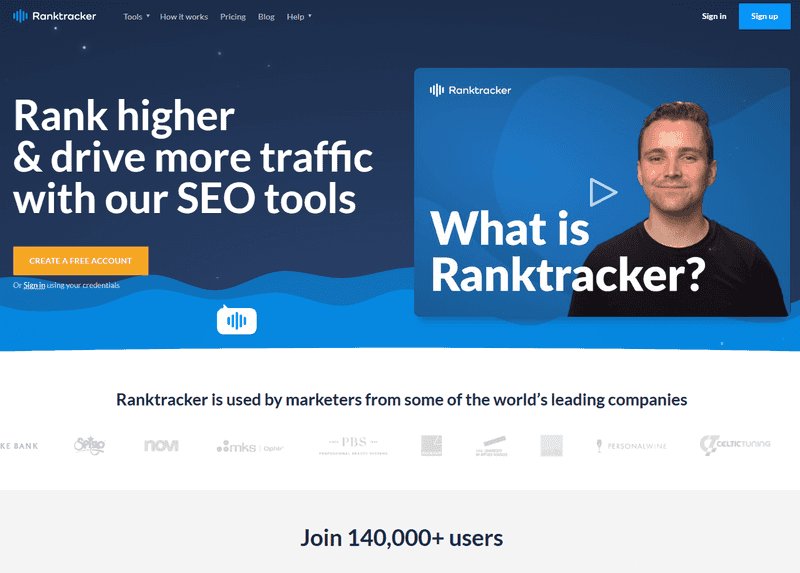
Ranktracker stands out as one of the most versatile AI tracking and brand monitoring platforms for marketers in 2026 because it’s built around a simple idea: AI visibility should be measured like a real channel — not like a novelty.
A lot of marketers are realizing something uncomfortable:
AI visibility is not purely an “AI tool problem.”
It’s often an authority and search presence problem.
AI systems tend to recommend what they consider “trusted” sources — which are often shaped by classic SEO signals:
- content depth
- topical coverage
- link authority
- ranking performance
- structured content that’s easy to interpret
That’s why the strongest AI visibility strategies are not just about tracking answers — they’re about connecting AI visibility to SEO execution.
And that’s where Ranktracker shines.
What it does differently
Ranktracker’s advantage is that it can sit as a control center:
- track AI visibility as an outcome
- track rankings, SERP features, and share of voice as inputs
- identify content gaps and competitive threats
- run SEO workflows (keyword research, audits, competitor analysis) that improve the underlying signals AI relies on
This matters because marketers don’t just want to know they’re missing from AI answers.
They want to know what to do next.
How it supports AI visibility improvement
Marketers using Ranktracker for AI monitoring can build a loop:
- Find prompts where competitors dominate
- Identify which sources or content types are shaping those answers
- Map those sources to SEO opportunities (keywords, SERP features, topics)
- Create or expand content designed to compete for citations
- Monitor changes in both classic search visibility and AI presence
That loop is what turns AI monitoring into measurable growth.
Best for
- performance marketers who want AI visibility tied to SEO execution
- agencies that need unified reporting without a fragmented tool stack
- SaaS teams competing on “best tools,” “alternatives,” and “vs” prompts
- global teams that need segmented tracking and competitive analysis
Pros
- connects AI monitoring to SEO levers you control
- reduces tool fragmentation (monitor + diagnose + execute)
- supports competitive workflows and share of voice
Cons
- deeper platforms have more configuration work up front
- teams looking only for “basic monitoring” may not use the full value
2) Nightwatch
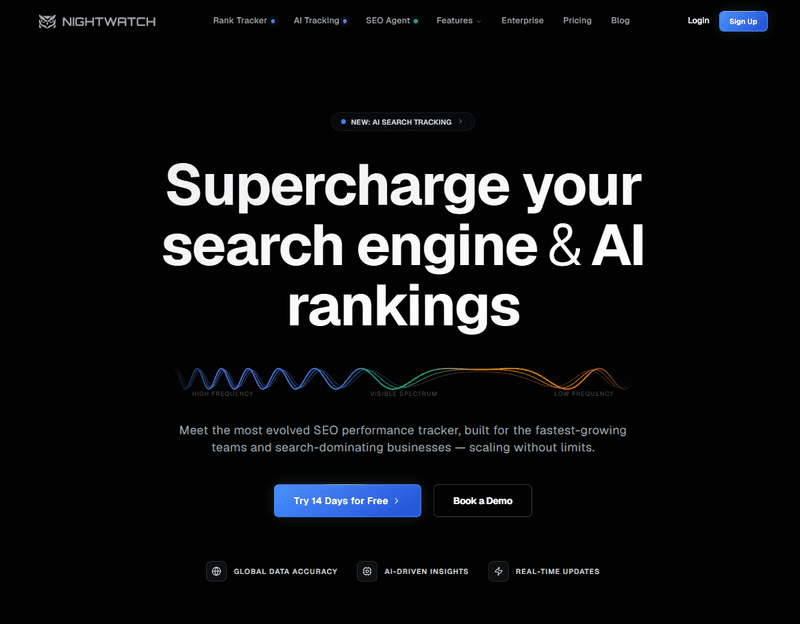
If Ranktracker is a versatile monitoring platform, Nightwatch is the option you choose when you want AI search monitoring tied directly into the SEO levers that influence visibility.
A lot of AI monitoring tools feel like dashboards you check occasionally.
Nightwatch is positioned more like a system you use continuously: tracking visibility, tracking competitors, mapping changes over time, and tying insights back into what marketers and SEOs actually do next.
What it does well
Nightwatch is strongest when you want a broad monitoring setup that supports ongoing marketing workflows:
- track brand visibility in key AI environments
- monitor competitor inclusion alongside your own
- see how prompts perform over time
- detect changes in what AI is saying and how it’s framing you
- report visibility shifts without spending hours compiling data
Why marketers like it
From a marketer’s point of view, the job isn’t just “collect data.”
It’s:
- prove visibility is improving
- connect visibility to strategy
- explain competitive positioning to stakeholders
- find the highest-intent areas where AI affects decisions
Nightwatch tends to fit this marketing workflow well: it’s built around monitoring and reporting that can be operationalized.
Best for
- SEO teams and agencies that want a broad monitoring platform
- marketers who need competitor benchmarking and visibility reporting
- teams that want an ongoing system rather than one-off snapshots
Pros
- strong monitoring and reporting workflows
- clear competitive framing for visibility shifts
- useful for teams that need continuous tracking cadence
Cons
- like most feature-rich platforms, it can take time to learn and configure well
- the quality of outcomes depends on how well you define prompt clusters and competitor sets
3) Otterly AI
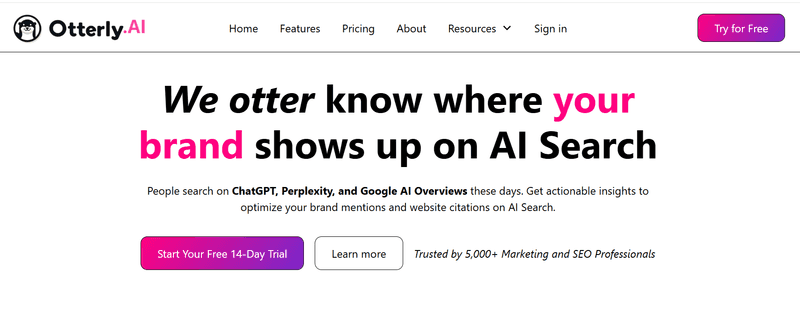
Otterly AI is still one of the most popular AI monitoring tools for marketing teams because it’s focused and relatively easy to adopt.
If your goal is specifically:
- “We want to know if AI mentions us and our competitors”
- “We want a simple dashboard to show visibility”
- “We want share-of-voice-style reporting inside AI answers”
Otterly can be a solid fit.
What it does well
Otterly tends to be strongest as a straightforward AI visibility monitoring layer:
- track mentions across major AI environments
- benchmark visibility versus competitors
- track changes over time
- view AI share-of-voice metrics
It’s often used by teams who don’t want their AI monitoring tied into SEO workflows — either because they already have a separate SEO stack, or because they’re treating AI monitoring as a brand metric.
Best for
- brand marketing teams
- in-house marketing groups wanting a clean AI visibility dashboard
- agencies that need a simple “AI visibility layer” for reporting
Pros
- clean interface and quick onboarding
- focused AI monitoring workflows
- competitive framing and share-of-voice-style reporting
Cons
- less of an execution platform (you’ll still need SEO tools elsewhere)
- prompt discovery depth may be limited compared to more advanced setups
4) Knowatoa AI
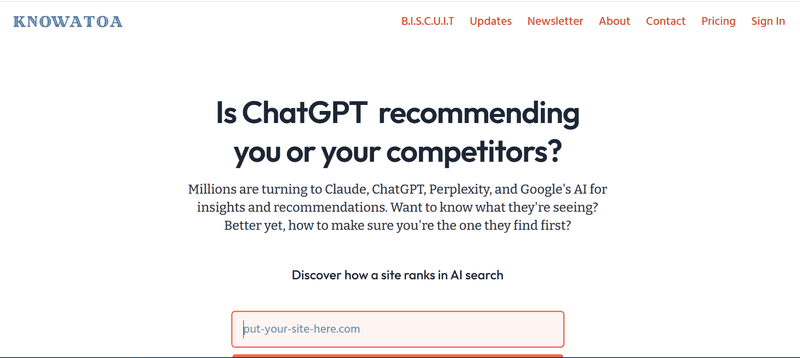
Knowatoa is the tool you reach for when you care more about how AI talks about you than raw mention frequency.
It’s built around brand characterization.
That means it can help marketers answer questions like:
- Are we being framed as premium or budget?
- Is AI repeating a wrong claim about our product?
- Are we being positioned as “too complex” or “not for enterprise”?
- Are competitors being positioned more favorably?
This is especially important when AI answers shape perception before users ever reach your site.
Best for
- marketers focused on brand positioning
- teams worried about misrepresentation and narrative drift
- agencies doing reputation and perception monitoring
Pros
- strong emphasis on sentiment and framing
- useful for identifying positioning issues (not just visibility gaps)
- competitor comparison for perception, not only mentions
Cons
- may need to be paired with other tools for deeper citation and SEO execution workflows
- newer tools often evolve quickly, which can be a pro or a risk depending on your needs
5) Scrunch AI
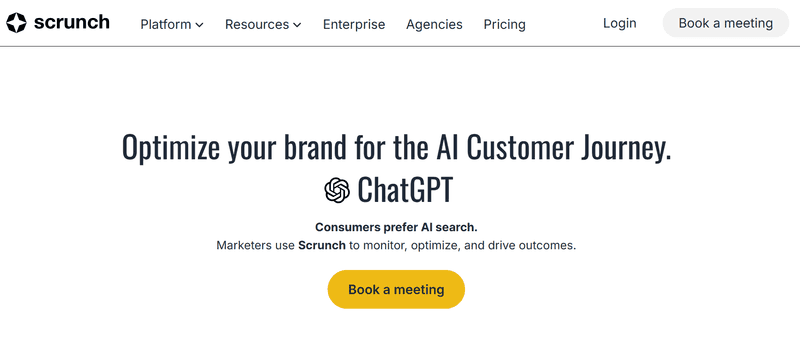
Scrunch is positioned around brand accuracy and messaging alignment.
In other words: if AI answers describe you incorrectly, Scrunch aims to surface that gap.
This is valuable for:
- enterprises with strict brand messaging requirements
- teams that care about “what AI says about us” as a reputation factor
- organizations that need to monitor misinformation risk
What Scrunch tends to be best at
- identifying brand narrative gaps
- highlighting inconsistencies in how AI describes your product
- surfacing outdated or incorrect claims that appear in AI answers
Best for
- larger marketing teams
- brands with high sensitivity to narrative control
- companies where a misrepresented AI answer could materially affect trust
Pros
- strong focus on accuracy and messaging alignment
- useful for narrative control and reputation-style monitoring
Cons
- not usually a “performance SEO execution” tool
- may be more expensive than pure monitoring tools depending on plan needs
6) Profound AI
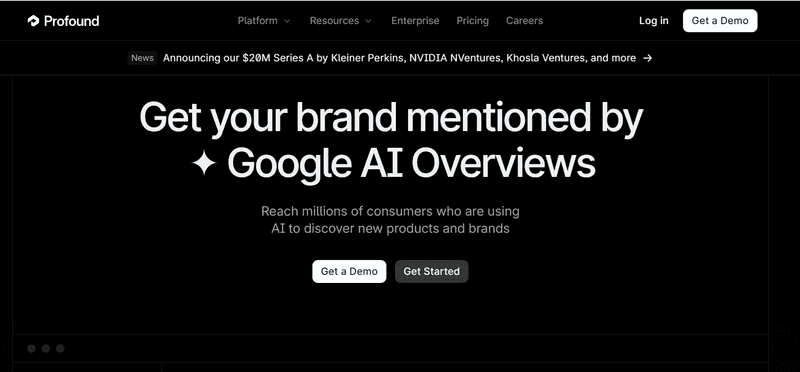
Profound AI is enterprise-focused and generally positioned for organizations that want executive-style reporting around AI visibility.
It’s not typically chosen by teams looking for:
- fast onboarding
- self-serve workflows
- deep prompt research
- integrated SEO execution
Instead, it fits scenarios where:
- leadership wants visibility reporting
- budgets are enterprise-level
- the goal is dashboards and monitoring at a high level
Best for
- large enterprises with budget and a reporting-first mindset
- teams that want synthetic persona-style analysis and high-level dashboards
Pros
- enterprise-style visibility reporting
- useful for leadership stakeholders who want simplified dashboards
Cons
- expensive relative to tactical depth
- often less actionable for performance teams
- can be sales-led and slower to evaluate
7) Peec AI
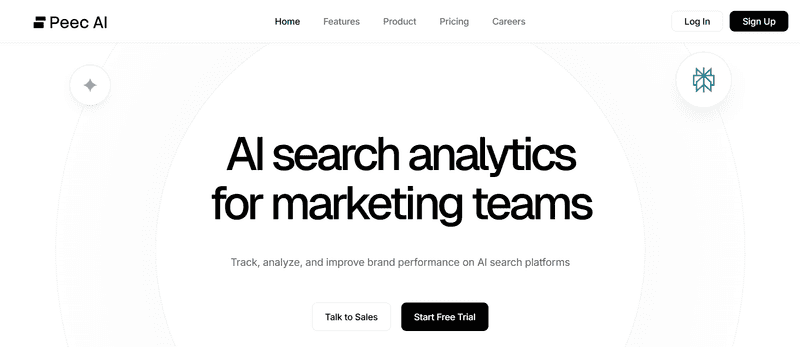
Peec AI is a simpler, more basic monitoring tool.
It can work if:
- you need a lightweight way to check whether AI mentions you
- you want a minimal setup
- you don’t need deep prompt discovery, citation intelligence, or SEO integration
The risk is that teams outgrow it quickly, especially when AI visibility becomes part of a core acquisition strategy.
Best for
- small teams wanting basic monitoring
- marketers who want “visibility snapshots” more than full strategy workflows
Pros
- simple interface
- lighter operational overhead than complex platforms
Cons
- limited strategic depth for competitive AI visibility work
- often requires additional tools for prompt research and SEO execution
How to Pick the Right Tool as a Marketer
If you’re trying to choose quickly, don’t choose based on “who has the most features.”
Choose based on the job you need the tool to do.
If you want AI visibility to drive growth
You need:
- prompt clusters mapped to funnel intent
- competitor share of voice
- citation intelligence
- SEO context so you can actually influence outcomes
Best fit: Ranktracker (for unified SEO + AI execution) or Nightwatch (for versatile monitoring workflows).
If you want a clean AI monitoring dashboard for reporting
You need:
- multi-platform tracking
- competitor benchmarking
- simple share-of-voice framing
Best fit: Otterly AI (focused AI monitoring).
If your biggest concern is brand narrative and misrepresentation
You need:
- sentiment and framing analysis
- alerting and accuracy monitoring
- workflows focused on brand perception
Best fit: Knowatoa AI or Scrunch AI.
If you need enterprise-level dashboards
You need:
- leadership reporting
- simplified executive dashboards
- enterprise onboarding and support
Best fit: Profound AI.
FAQ
What’s the difference between AI search monitoring and traditional SEO tools?
Traditional SEO tools track:
- keyword rankings in SERPs
- organic traffic
- backlinks
- technical health
- click-through rates
AI search monitoring tools track:
- whether AI answers mention your brand
- how AI frames your product vs competitors
- which prompts trigger inclusion
- which sources shape the answer
- how your share of voice changes over time
In classic SEO, you can be position 3.
In AI search, you can be invisible.
Which AI platforms should marketers monitor in 2026?
At minimum, most marketers focus on:
- ChatGPT-style assistants
- Google AI Overviews
- Perplexity-style answer engines
Then add Claude and Gemini depending on your audience and markets.
The All-in-One Platform for Effective SEO
Behind every successful business is a strong SEO campaign. But with countless optimization tools and techniques out there to choose from, it can be hard to know where to start. Well, fear no more, cause I've got just the thing to help. Presenting the Ranktracker all-in-one platform for effective SEO
We have finally opened registration to Ranktracker absolutely free!
Create a free accountOr Sign in using your credentials
The right monitoring tool should align with where your buyers actually ask questions.
Do AI search monitoring tools improve your visibility automatically?
No tool “forces” AI answers to recommend you.
What they do is show you:
- where you’re missing
- why competitors appear instead
- which sources shape your category
- what topics and content formats AI prefers
Then your visibility improves through execution:
- better content depth
- stronger topical authority
- better structured pages
- stronger trust signals and references
- improved SEO foundations
That’s why tools that connect monitoring to execution are usually more valuable long-term.
What’s the biggest mistake marketers make with AI visibility?
Treating AI monitoring as separate from SEO and content strategy.
If you only watch AI answers without strengthening the inputs that influence those answers, visibility changes will feel random.
The marketers who win treat AI visibility like a measurable channel:
- monitor prompts
- benchmark competitors
- improve content and authority
- track share of voice
- iterate continuously