Intro
If you are still running SEO like it is 2019, you are playing the wrong game. An effective AI SEO strategy in 2026 is not about stuffing keywords or just ranking number one. It is about getting your content cited inside AI-generated answers.
A lot of teams think using AI tools for SEO means they are ready for AI search. Writing with AI is different from building content that ChatGPT and Perplexity trust and cite.
Today, SEO for ChatGPT and SEO for Perplexity means building pages that answer real questions clearly, stay tightly structured, and signal authority without trying too hard. This guide will walk you through the framework, the execution steps, and how to measure real AI visibility, not just rankings.
What Is an AI SEO Strategy in 2026?
An AI SEO strategy in 2026 is not just about ranking on Google. It is about being selected, summarized, and cited by AI systems. That includes ChatGPT, Perplexity, and Google’s AI Overviews.
This is where generative engine optimization comes in. Traditional SEO focuses on ranking pages. Generative engine optimization focuses on becoming a trusted source inside AI-generated answers. Those are two different games.
AI models look for three things: clear entities, structured answers, and strong authority signals.
The All-in-One Platform for Effective SEO
Behind every successful business is a strong SEO campaign. But with countless optimization tools and techniques out there to choose from, it can be hard to know where to start. Well, fear no more, cause I've got just the thing to help. Presenting the Ranktracker all-in-one platform for effective SEO
We have finally opened registration to Ranktracker absolutely free!
Create a free accountOr Sign in using your credentials
You can rank number one and still never appear in an AI answer. If your content is not structured for extraction and clarity, the model will simply cite someone else. And most marketers are still not adjusting for that shift.
How ChatGPT and Perplexity Select Sources
To improve SEO for ChatGPT and SEO for Perplexity, you must understand how they choose sources.
How ChatGPT Chooses Sources
ChatGPT relies heavily on Bing’s index and trusted web data. That means your site still needs solid technical SEO and strong authority. But that is just table stakes. ChatGPT looks for clear entity signals so it understands your brand and expertise. It also favors structured summaries and consistent topical depth. When your brand consistently shows up around one topic across multiple pages, AI systems start to connect the dots.
How Perplexity Selects Citations
Perplexity works differently. It crawls the web in real time and displays citations openly. Its architecture is citation-first, meaning it prefers sources with clear, quotable paragraphs. Short, direct answers usually win. Domain trust still matters, but formatting plays a bigger role. If your content is easy to extract and clearly structured, Perplexity is far more likely to reference it.
Core Pillars of a High-Performing AI SEO Strategy
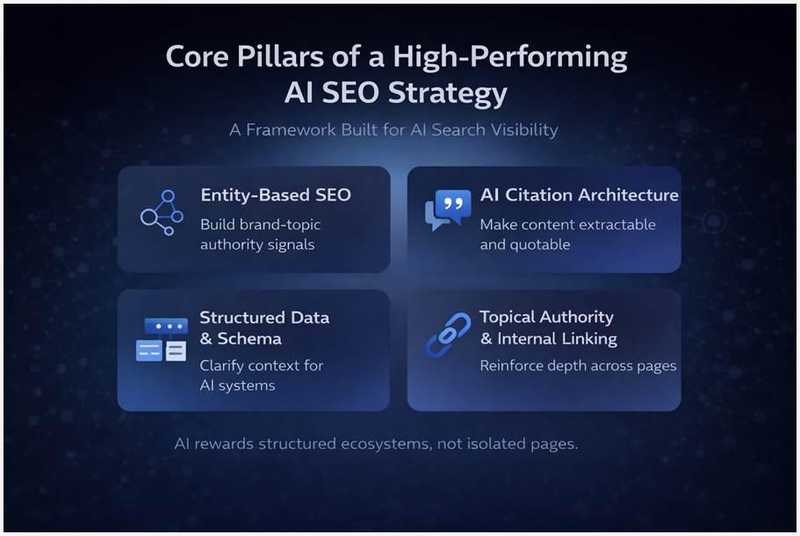
If you want real AI search optimization, you need a framework, not hacks or random tweaks. A repeatable system that makes your brand easy for AI systems to understand, trust, and cite.
Here are the four pillars that consistently move the needle.
1. Entity-Based SEO
Entity-based SEO means optimizing around who you are and what you are known for, not just keywords. Search engines map brands to topics. Depth and repetition make that relationship clear over time.
You reinforce this through structured topical clusters. Instead of one blog post on AI visibility, you build connected resources. At Logic Inbound, we have covered answer engine optimization in depth in our guide on answer engine optimization and expanded further in our breakdown of how to optimize content for Google AI Overviews.
2. AI Citation Architecture
This is where most brands quietly lose visibility.
AI citation architecture means writing content in a way that AI systems can easily extract and quote. If you want to go deeper into how answer engines evaluate and prioritize sources, understanding a strong answer engine optimization strategy becomes critical. You create clear definition blocks. You answer questions directly before expanding. You use micro summaries that restate the core idea in simple language.
Data-backed claims increase trust. Fluff and long storytelling reduce clarity.
The All-in-One Platform for Effective SEO
Behind every successful business is a strong SEO campaign. But with countless optimization tools and techniques out there to choose from, it can be hard to know where to start. Well, fear no more, cause I've got just the thing to help. Presenting the Ranktracker all-in-one platform for effective SEO
We have finally opened registration to Ranktracker absolutely free!
Create a free accountOr Sign in using your credentials
If a paragraph cannot stand alone as a quote, AI will likely skip it.
3. Structured Data and Schema for AI Search
Structured data for AI search helps machines understand your content faster. FAQ schema clarifies question and answer pairs. Article schema defines context. HowTo schema works for step-based content. Author schema reinforces expertise and trust.
Schema reinforces clarity and supports trust signals.
4. Topical Authority and Internal Linking
Authority is built through depth. Topic clusters help reinforce your expertise. Deep internal linking connects related pages so AI systems see consistent coverage.
For example, linking to real-world results such as our case study on ranking in AI chatbots strengthens cross-page reinforcement. When multiple pieces support the same theme, your authority becomes harder to ignore.
AI does not reward isolated content. It rewards structured ecosystems.
How to Optimize Content Specifically for ChatGPT and Perplexity
Now let’s get practical. If your goal is to optimize content for ChatGPT and improve your SEO for Perplexity, you need to adjust how you write and structure pages. This is where your AI visibility strategy becomes real.
Content Formatting That Wins AI Citations
Start with direct answers. If someone asks, “What is an AI SEO strategy?” the first paragraph under that heading should answer it immediately. Do not make readers scroll through a life story first.
Use clean H2 and H3 headings. Keep paragraphs short and focused so they can stand alone as quotes. Ask natural language questions and write as if explaining it to a client.
If it is clear to a human, it is easier for AI to extract.
Writing for Prompt-Based Search
AI search is driven by prompts. People ask full questions now. They compare options. They request step-by-step plans.
Your content should reflect that. Provide multi-angle answers instead of one narrow explanation. Add short answer expansion blocks where you define something and then go deeper. Reinforce context so AI understands the topic fully.
How to Measure AI Visibility and AI Referral Traffic
If you cannot measure it, you cannot improve it. Measuring AI visibility is now a core part of any serious strategy.
The All-in-One Platform for Effective SEO
Behind every successful business is a strong SEO campaign. But with countless optimization tools and techniques out there to choose from, it can be hard to know where to start. Well, fear no more, cause I've got just the thing to help. Presenting the Ranktracker all-in-one platform for effective SEO
We have finally opened registration to Ranktracker absolutely free!
Create a free accountOr Sign in using your credentials
Start with GA4. Create a custom report and filter referral sources for chat.openai.com and perplexity.ai. That is your baseline for AI referral traffic. The numbers may look small at first, but they show whether AI systems are actually surfacing your brand.
Next, manually test brand queries inside ChatGPT and Perplexity. Are you mentioned? Are competitors being cited instead? Track this monthly.
Also monitor impressions in Google Search Console for AI Overview-heavy queries. You may notice traffic patterns change even when rankings stay stable.
Rankings alone do not tell the full story anymore. AI search analytics requires tracking citations, referrals, and brand visibility.
FAQs
Does ranking #1 guarantee ChatGPT mentions your site?
No, ranking first in Google does not guarantee ChatGPT will cite you. AI systems choose sources that are clear, structured, and easy to quote. If your competitor’s content is easier to summarize or better aligned with the question, they may get cited instead.
How do I optimize my website for Perplexity AI?
Focus on structured content, short quotable paragraphs, and clear answers under proper headings. Build topical authority around one subject and make sure your domain has trust signals. Perplexity favors pages that are easy to cite and clearly formatted.
Is AI SEO different from traditional SEO?
Yes, traditional SEO focuses on ranking pages. Generative engine optimization focuses on being selected and summarized by AI systems. You still need strong SEO fundamentals, but you must also optimize for citation and extraction.
How can I track traffic from ChatGPT?
Use GA4 and filter referral traffic for sources like chat.openai.com. Monitor those visits over time and compare them against brand visibility inside AI tools to understand your true AI impact.